Hotel Sustainability Claims: What Changes on 27 September
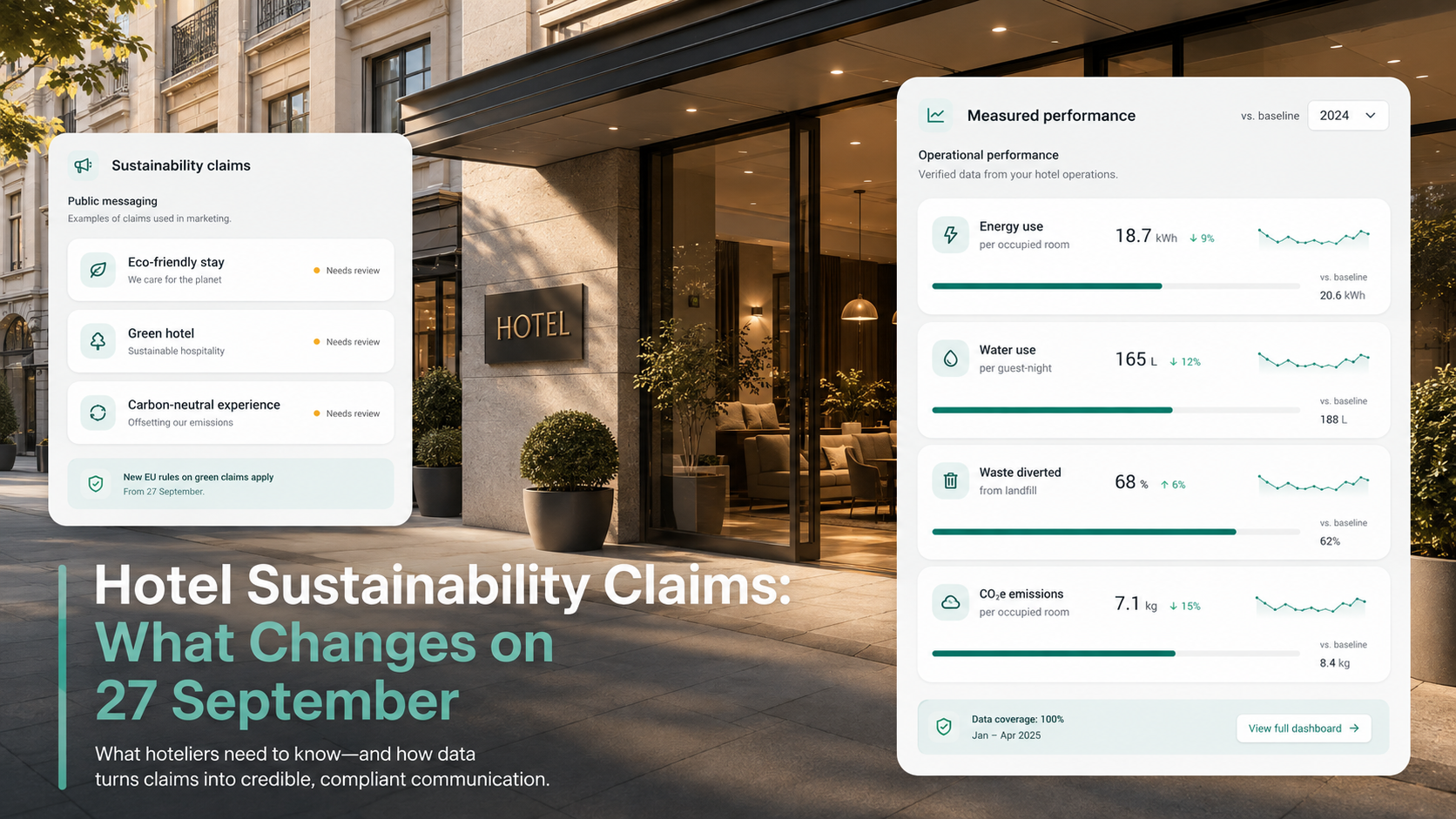
"Sustainable hotel."
"Eco-friendly stay."
"Green accommodation."
"Carbon-neutral experience."
These phrases are familiar across hotel websites, booking pages, brochures and social media.
From 27 September 2026, some of that language becomes considerably harder to use casually in the European Union.
That is the date from which EU Member States are required to apply the national measures implementing Directive (EU) 2024/825 on empowering consumers for the green transition. The Directive strengthens existing EU consumer-protection rules against misleading environmental claims, unreliable sustainability labels and several other forms of greenwashing.
For hotels, however, this is more than a marketing compliance exercise.
It exposes a wider operational challenge:
You cannot make credible, specific sustainability claims if you cannot reliably measure your environmental performance.
Certification, substantiation and the legal basis for any particular claim will still depend on the claim itself and the applicable national rules. Monitoring water or energy does not automatically make an environmental statement compliant.
But if a hotel wants to communicate that it has reduced water consumption, improved energy performance or cut resource waste, it needs to know what changed, compared with what, over which period and using which methodology.
That makes measurement part of the infrastructure behind credible sustainability communication.
This article provides general information and should not be treated as legal advice. Hotels should obtain appropriate legal review for specific environmental claims.
Sustainability language is about to face a higher bar
The European Commission has long identified a credibility problem around environmental marketing. Its Green Claims information page reports that 53% of environmental claims examined were vague, misleading or unfounded, while 40% had no supporting evidence.
Directive 2024/825 addresses part of that problem by amending the EU's existing Unfair Commercial Practices Directive.
One important change concerns generic environmental claims.
The Directive gives examples such as "environmentally friendly", "eco-friendly", "green", "climate friendly" and similar wording. Such generic claims are prohibited where the trader cannot demonstrate what the legislation calls "recognised excellent environmental performance" relevant to the claim.
That definition matters.
It does not simply mean that a hotel's management team believes it performs well. The Directive ties the concept to defined mechanisms such as the EU Ecolabel, officially recognised ISO 14024 Type I ecolabelling schemes, or top environmental performance under applicable EU law. The EU Ecolabel itself has specific criteria for tourist accommodation.
The practical lesson is not that hotels must stop communicating sustainability.
It is that broad adjectives deserve much more scrutiny.
What Directive 2024/825 actually changes for hotels
The easiest way to understand the rules is not to read them as abstract legislation, but to apply them to typical hotel communications.
| Hotel communication | Question to ask |
|---|---|
| "We're an eco-friendly hotel." | This is likely a generic environmental claim. Can the hotel demonstrate the recognised excellent environmental performance relevant to such a broad statement? |
| "We've reduced water consumption by 18%." | What was the baseline? Over which period? Is consumption total or normalised for occupancy? How was the 18% calculated, and can the underlying evidence support the statement? |
| "Our rooms are sustainable." | Which environmental characteristics does this describe? Does the statement imply performance across the whole room or stay when the evidence concerns only one aspect? |
| A sustainability badge on the booking page | Is the label established by a public authority or based on a certification scheme meeting the Directive's requirements? |
| "Carbon-neutral stay" because emissions have been offset | The Directive specifically prohibits claims that a good or service has a neutral, reduced or positive greenhouse-gas impact when that claim is based on emissions offsetting. |
| "We will be climate neutral by 2030." | Is there a detailed and realistic implementation plan, measurable time-bound targets and the required independent third-party verification? |
There are several important distinctions behind this table.
Generic claims are not the same as specific claims
"Eco-friendly hotel" and "we reduced water use per guest-night by 18% between 2025 and 2026" are fundamentally different statements.
The Directive distinguishes generic claims from claims whose specification is provided clearly and prominently on the same medium. Its recitals contrast broad wording with more specific environmental information.
Specific does not mean automatically compliant.
A quantified claim can still mislead consumers if the baseline, calculation, context or presentation produces a false impression.
But specificity creates something marketing, ESG and operations can actually interrogate:
Where did the number come from?
One sustainable initiative does not make the whole business sustainable
Another newly prohibited practice is making an environmental claim about an entire product or business when the evidence concerns only a particular aspect or activity.
For hotels, this is especially relevant.
Installing photovoltaic panels, removing plastic bottles or introducing a towel-reuse programme may be worthwhile interventions.
But one initiative does not automatically substantiate a broad claim about the environmental performance of the whole property.
Sustainability labels need scrutiny too
From 27 September, displaying a sustainability label that is neither based on a qualifying certification scheme nor established by public authorities is added to the EU's list of prohibited commercial practices.
Hotels should therefore inventory every environmental badge, icon and sustainability mark shown across their own website, booking engine and other consumer communications.
Offset-based carbon-neutral claims face a particularly clear restriction
The Directive specifically targets claims that a product, which in this context can include a service, has a neutral, reduced or positive greenhouse-gas impact based on offsetting.
The legislation gives examples including "climate neutral", "CO2 neutral certified", "carbon positive" and "climate compensated". It distinguishes those claims from reductions based on the actual lifecycle impact of the product or service.
Hotels can still communicate investments in climate projects where this is done accurately and without misleading consumers. What changes is the ability to use those offsets to present the stay itself as carbon neutral or lower-impact.
Why Hotel Sustainability Basics is changing too
This is not only a regulatory interpretation.
The hospitality sector is already adapting.
In June 2026, the World Travel & Tourism Council announced that Hotel Sustainability Basics would transition to an independent third-party certification scheme, explicitly connecting the change to Directive 2024/825 and its stricter requirements for environmental claims. WTTC says the programme has now been adopted by more than 8,000 hotels across 85 countries.
The direction is revealing.
Hotel Sustainability Basics does not begin with advertising language. Four of its core efficiency criteria are:
- measure and reduce energy use;
- measure and reduce water use;
- identify and reduce waste;
- measure and reduce carbon emissions.
WTTC also highlights tracking and benchmarking as tools for understanding environmental impact and improving operations.
The sequence matters.
Measure. Reduce. Demonstrate. Then communicate.
Not the other way around.
An initiative is not the same thing as evidence
Hotels have spent years implementing sustainability initiatives:
LED lighting. Low-flow fixtures. Heat pumps. Photovoltaics. Towel and linen reuse. Recycling. Guest engagement programmes. Building-management controls.
These actions can be valuable.
But they describe what the hotel installed or changed.
They do not automatically demonstrate what the intervention achieved.
A low-flow showerhead has a rated flow rate. That does not tell you the property's actual reduction in water consumption.
A heat pump has a predicted efficiency. That does not tell you how the building performs under real occupancy, weather and operating schedules.
A photovoltaic installation has a rated capacity. That does not tell you the proportion of hotel demand met through on-site generation.
This is the measurement gap behind sustainability communication.
A stronger operating model is:
Action -> Measurement -> Baseline -> Outcome -> Evidence -> Claim
rather than:
Action -> Sustainability claim
The distinction becomes even more important when the claim contains a number.
What should hotels actually measure?
There is no single metric that substantiates every sustainability statement.
The right evidence depends on what the hotel wants to understand or communicate.
For operational resource performance, useful indicators can include:
| Area | Potential metric |
|---|---|
| Energy | kWh per occupied room |
| Water | litres per guest-night |
| Water | litres per occupied room |
| Waste | kg per guest-night or kg per cover |
| Food waste | kg per cover |
| Renewable energy | kWh generated and percentage self-consumed |
| Energy or water projects | consumption before versus after intervention |
| Portfolio performance | normalised consumption by property |
| Operational waste | anomalous consumption detected and corrected |
The key word is normalised.
Suppose a hotel's total water consumption falls by 8% while occupancy falls by 15%.
Has water efficiency improved?
Not necessarily.
Conversely, total electricity use might rise during a year in which occupied room-nights increase considerably, while energy consumption per occupied room actually improves.
This is why sustainability performance cannot always be understood from utility bills alone.
Context matters: occupancy, guest-nights, weather, operating hours, floor area, food-and-beverage activity and changes in building use can all affect interpretation.
For hotels facing water stress, this is also an operational resilience issue. The same measurement discipline behind hotel water monitoring can help teams connect environmental claims to real operating context.
Example: from low-flow showerheads to a supportable claim
Imagine a 150-room hotel replacing showerheads across its rooms.
The installation itself allows the hotel to say something factual such as:
"We installed lower-flow showerheads in all guest bathrooms."
But suppose the hotel wants to go further:
"The project reduced guest-room shower water consumption by 22%."
That requires another layer of evidence.
A credible measurement process might compare a representative baseline period with post-installation consumption, account for occupancy, maintain a consistent measurement boundary and document any other operational changes that could materially affect the result.
If measured shower consumption falls from an average of 42 litres to 32.8 litres per occupied room, that represents a measured reduction of approximately 22% within that defined boundary.
Now the hotel has something more useful than a sustainability adjective.
It has an operational result.
That still does not remove the need to review whether a particular consumer-facing claim is legally appropriate. But it gives the ESG and marketing teams evidence they can interrogate instead of asking operations to substantiate a statement after it has already been written.
A practical sustainability-claims audit before 27 September
Hotels do not need to wait for a complaint or regulatory challenge to review their communications.
A practical audit can start now.
1. Inventory environmental claims
Search the hotel website, booking engine, OTA descriptions, brochures, sales decks, in-room materials, newsletters and social channels.
Do not look only for the word "sustainable".
Search for language such as:
green, eco, environmentally friendly, climate friendly, responsible, low-carbon, carbon neutral, zero-impact, energy efficient and water efficient.
2. Flag generic claims
Identify statements that communicate environmental superiority without explaining precisely what that means.
Ask whether the claim is necessary and what legal basis supports it.
3. Inventory sustainability labels
Record every voluntary badge or certification displayed in consumer-facing communication.
Confirm who operates the scheme and whether the label satisfies the relevant requirements.
4. Map specific claims to evidence
For every measurable statement, document the supporting source.
That might include metering data, invoices, certification evidence, waste records, building-management data or another appropriate source.
5. Record the baseline and methodology
"18% less water" is incomplete internally unless the organisation knows:
18% less than what?
Record the comparison period, measurement boundary, normalisation method and calculation.
6. Connect marketing, ESG and operations
The three functions should not operate sequentially.
Marketing knows what the organisation wants to communicate.
ESG understands reporting and sustainability frameworks.
Operations knows what actually happens in the building.
Credible claims require all three.
7. Review claims as performance changes
Environmental performance is dynamic.
Occupancy changes. Equipment deteriorates. Leaks appear. Operating schedules drift. New assets are installed.
A statement supported by 2025 performance should not remain online indefinitely without review.
8. Obtain legal review where necessary
Operational data provides evidence.
It does not provide legal approval.
Broad environmental claims, certifications, climate statements and high-profile campaigns deserve appropriate legal review against the legislation applicable in the relevant market.
We turned this section into a dedicated guide: Hotel Sustainability Claims Audit Checklist.
The bigger shift: sustainability communication becomes operational
Directive 2024/825 is sometimes described simply as an anti-greenwashing measure.
For hotels, its practical significance may be broader.
It strengthens the connection between what happens inside the building and what the organisation can confidently say outside it.
Marketing can no longer be the place where sustainability evidence is assembled at the end of the process.
The evidence begins with operations.
How much water are we using?
Where?
Compared with which baseline?
How much energy does an occupied room require?
Did that intervention produce the expected saving?
Was the improvement sustained six months later?
Can we reproduce the calculation?
Those are operational questions before they are communication questions.
And they point towards a more useful model of hotel sustainability:
Measure performance. Improve what matters. Then communicate what the evidence can support.
Noytrall helps hospitality operators monitor water and energy use, understand performance in operating context, detect waste and turn building resource data into measurable sustainability action.
See how Noytrall turns building resource data into measurable sustainability performance.
Frequently asked questions
What happens on 27 September 2026?
EU Member States are required to apply the national measures implementing Directive (EU) 2024/825 from 27 September 2026. The Directive strengthens EU consumer-protection rules concerning environmental claims, sustainability labels and other commercial practices.
Can hotels still call themselves sustainable or eco-friendly?
Hotels should treat such broad environmental language carefully. The Directive specifically restricts generic environmental claims where the trader cannot demonstrate "recognised excellent environmental performance" relevant to the claim. Whether a specific statement is lawful depends on its wording, context and applicable national law.
Does every hotel sustainability claim need third-party certification?
No. The Directive does not simply impose third-party certification on every environmental statement. Different rules apply to different types of claims. Sustainability labels, future-performance claims and generic claims raise different requirements. Specific statements remain subject to existing rules against misleading commercial practices.
Are carbon-neutral hotel stays banned?
The Directive prohibits claims that a good or service has a neutral, reduced or positive greenhouse-gas impact when that claim is based on offsetting emissions. It does not prevent a company from communicating investments in environmental or carbon-credit projects where that communication is accurate and not misleading.
Does measuring water and energy make a sustainability claim compliant?
No. Measurement can provide evidence for relevant operational claims, but legal compliance depends on the specific statement, methodology, context, applicable consumer law and, where relevant, certification or verification requirements. Measurement supports substantiation; it does not replace legal review.