Hotel Solar and Battery Storage: When Does It Pay Off?
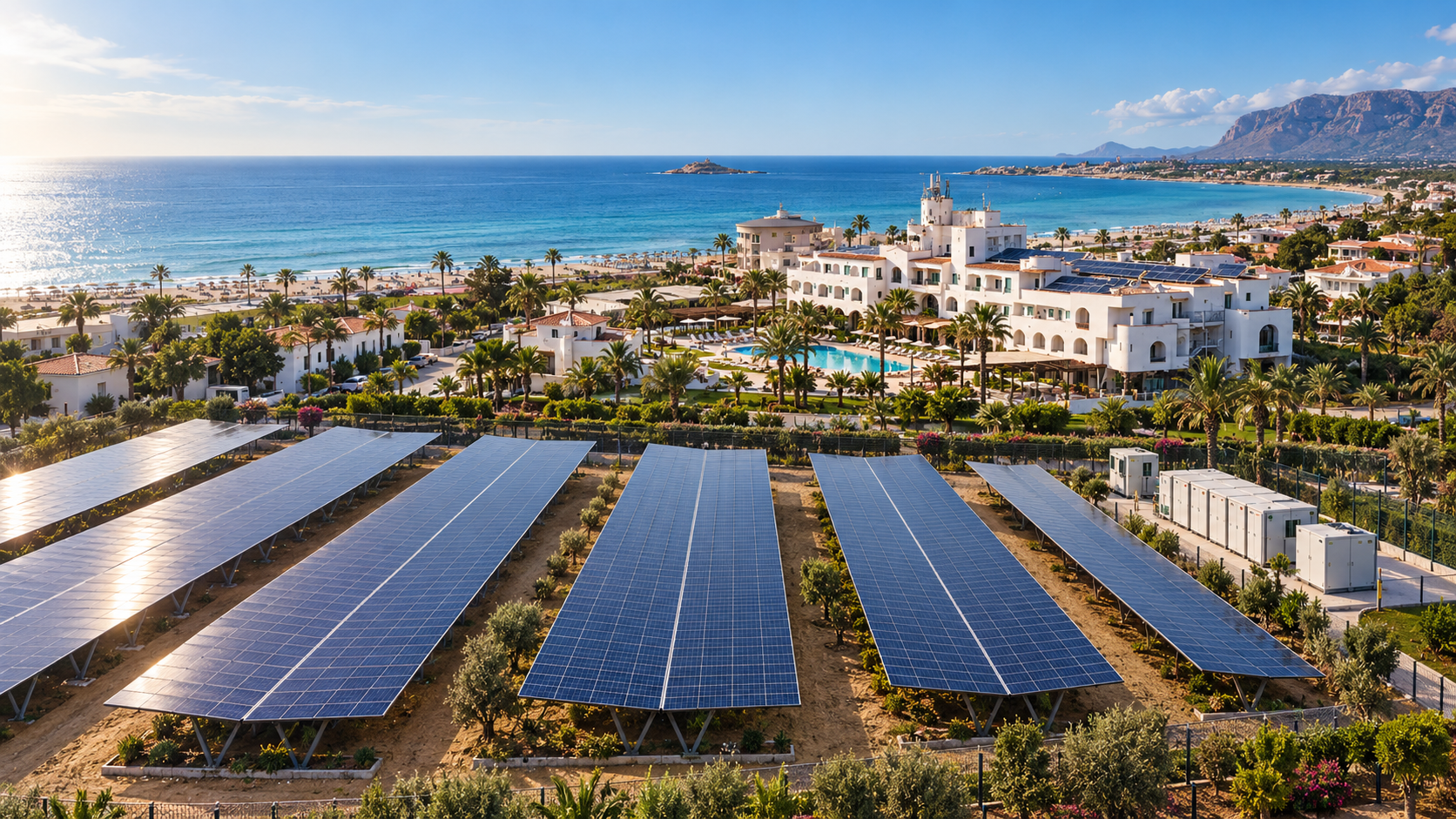
Solar and battery storage can materially reduce hotel energy costs, but the economics depend on how generation matches the property's real load. Illustrative image generated with AI.
A hotel in Sicily has just provided an eye-catching example of the potential economics of on-site renewable energy.
On 9 September 2026, industry reporting detailed a new solar-carport and battery-storage installation at the Saracen Sands Hotel & Conference Centre, near Palermo. The integrated system is forecast to generate around 1.5 GWh of electricity per year, meet up to 90% of the hotel's electricity needs and cut its annual electricity bill by approximately EUR 500,000.
The expected payback is reported at less than four years.
Those are significant numbers.
But one word matters: expected.
The EUR 500,000 saving and sub-four-year payback are project forecasts. They are not yet a multi-year record of measured savings.
And that distinction gets to the heart of how hotels should evaluate solar and battery storage.
Solar panels tell you how much electricity you can generate. A hotel's consumption profile determines how much that electricity is actually worth.
The strongest solar business case therefore does not start with the roof, car park or number of panels.
It starts with the load.
Sicily provides a useful solar and storage case
The Saracen Sands project is unusually interesting because it combines generation and storage at substantial scale.
According to industry reporting, the hotel already had approximately 150 kW of rooftop PV. A new 850 kW solar carport brings total installed capacity to around 1 MW, while eight battery units provide more than 2 MWh of storage.
The storage system is intended to shift surplus daytime generation into later hours, increasing the amount of locally generated electricity that can be used by the property.
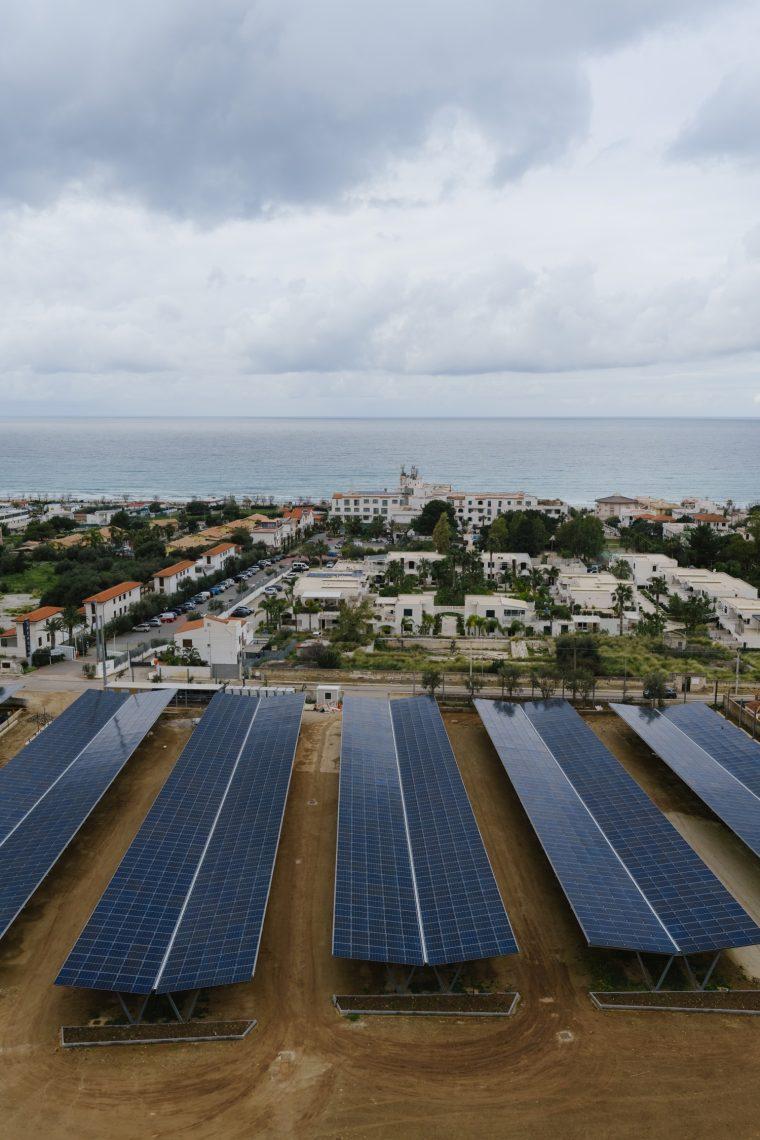
The new solar-carport installation at Saracen Sands Hotel & Conference Centre in Sicily. The project expands the property's photovoltaic capacity to approximately 1 MW.
ANSA had independently reported the broader investment programme several days earlier, including the roughly 1 MW photovoltaic expansion and previous EU-supported measures covering solar PV, solar thermal and air-conditioning improvements.
Noon's case study also describes the system as managed through an energy management system that integrates photovoltaic production and storage to support self-consumption, peak management and continuous monitoring.
The project therefore provides a useful real-world reference.
But its biggest lesson for another hotel is not:
Install 1 MW of solar and a 2 MWh battery.
It is:
Design generation and storage around how the property actually consumes electricity.
Annual electricity consumption is not enough to size solar
Consider a simple statement:
A hotel consumes 1.5 GWh of electricity per year, and its proposed PV system will generate 1.5 GWh per year.
It is tempting to conclude that solar could cover 100% of the hotel's electricity requirement.
It cannot be concluded from those two numbers.
Electricity has a time dimension.
Solar generation rises during daylight hours and normally peaks around the middle of the day. Hotel demand follows a very different pattern.
Breakfast production may create a morning load. Cooling may rise through a hot afternoon. Laundry can create large controllable loads. Restaurants return during lunch and dinner. Guest-room HVAC and appliances respond to occupancy. Conferences can change an otherwise predictable weekday. Pools, pumps, kitchens and hot-water systems each have their own operating schedules.
A megawatt-hour produced when the hotel needs it can therefore have a different financial value from a megawatt-hour produced when the hotel does not.
The European Commission's 2026 recommendation on self-consumption makes this problem explicit: renewable generation and consumption profiles often do not coincide, so surplus electricity may be exported at one time and electricity may be needed again later. Storage, energy management systems and demand-side flexibility can increase the share consumed on site.
This is why the starting point for a hotel solar project should be a load curve, not just the annual electricity bill.
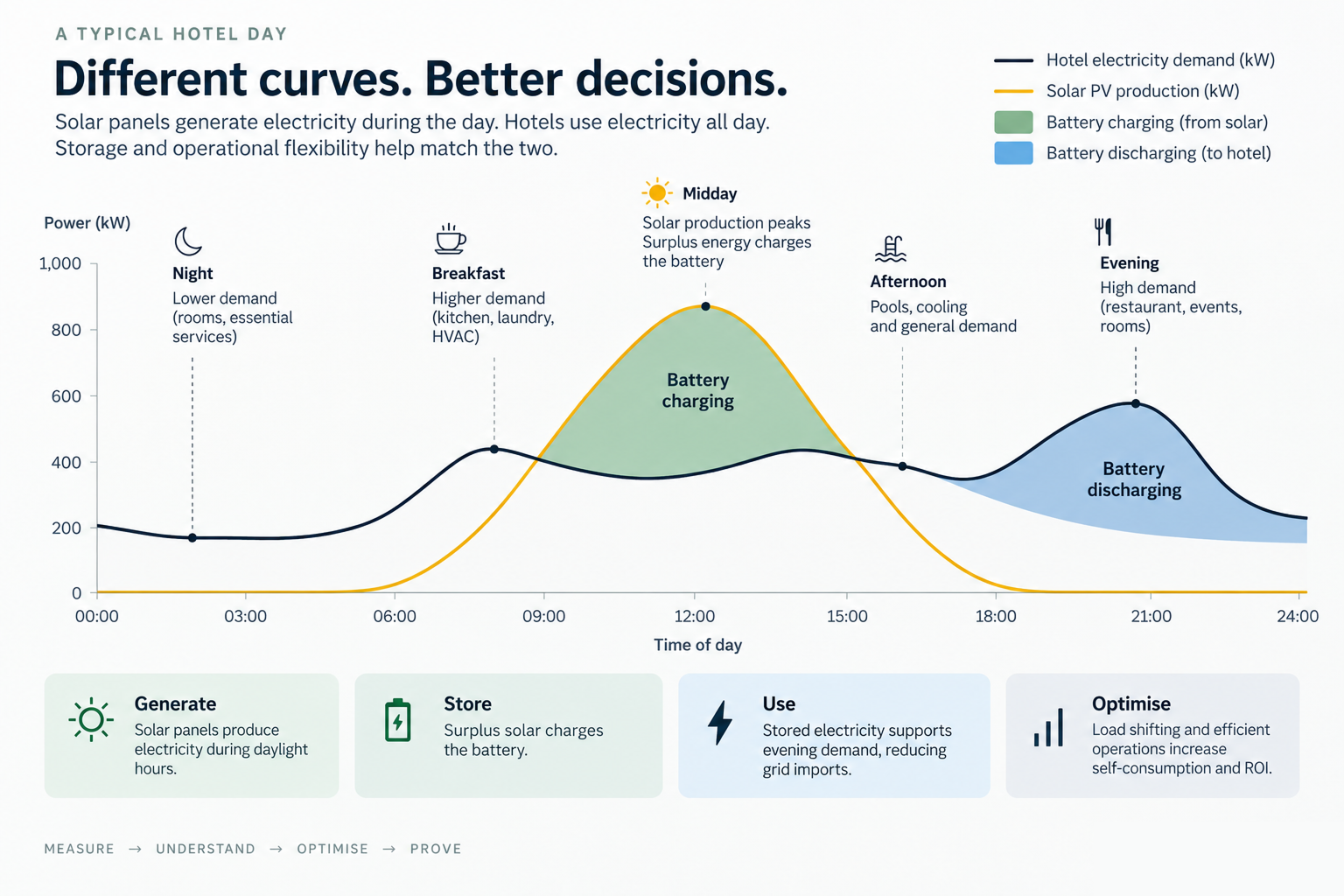
A typical hotel day: solar production, electricity demand and storage value rarely follow the same curve. Battery storage and operational flexibility help close the timing gap.
Step 1: Measure the hotel's real load
Before modelling PV, operators should understand when electricity is being consumed.
Ideally, the baseline should capture a full operating cycle so that the analysis includes high and low occupancy periods, heating and cooling seasons, weekends, events and any seasonal closures.
The important questions are operational:
When does demand peak? What is the minimum overnight baseload? How different are summer and winter? What changes when occupancy rises? Which loads are fixed, and which can move to another hour?
A hotel consuming 1.5 GWh annually could have very different investment economics from another hotel consuming exactly the same amount.
One might have strong daytime consumption that naturally coincides with solar production.
The other might have more demand concentrated in the morning and evening.
Same annual kWh. Different solar ROI.
Granular energy monitoring can also identify loads that should be reduced before adding generation. There is little financial logic in sizing a renewable-energy system to supply avoidable waste.
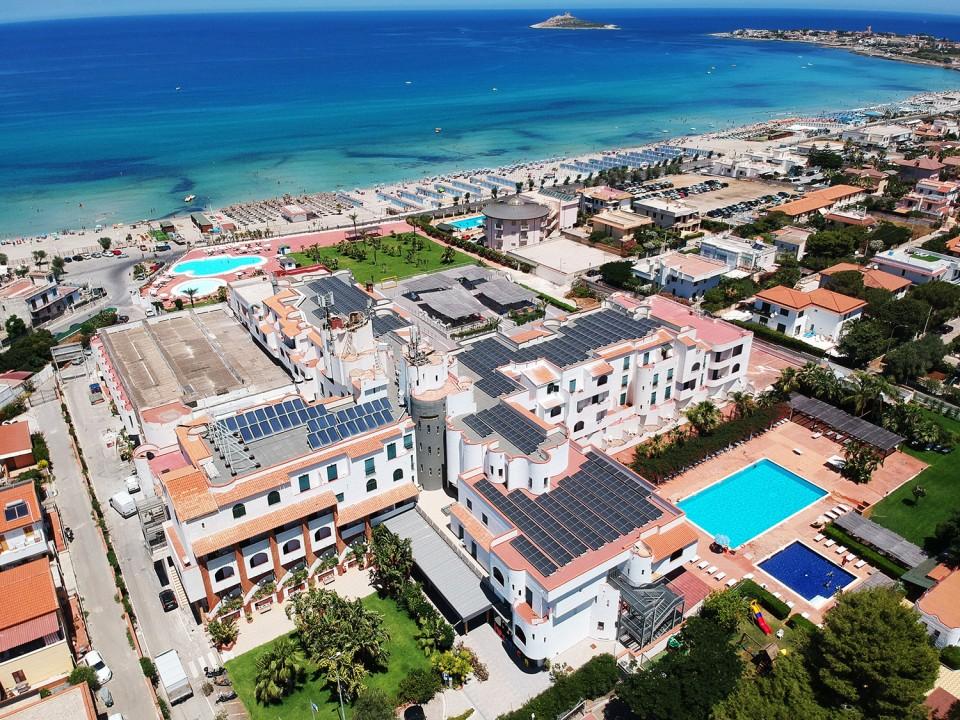
Saracen Sands had already deployed photovoltaic generation across several hotel roofs before the latest solar-carport expansion.
Solar investment can evolve over time. Operators are not necessarily making one isolated PV decision; they may be adding capacity to an asset whose demand, equipment and operating model are also changing.
Step 2: Size generation around consumption, not just available space
Once the load profile is understood, operators can model different PV capacities against it.
The objective is not necessarily to maximise the number of panels.
It is to understand what happens to every additional kWh generated.
At any given moment, solar electricity can be consumed immediately by the hotel, stored for later use or exported to the grid.
Those paths need not have equal financial value.
Electricity consumed on site can avoid buying a kWh from the grid. Electricity exported receives whatever compensation applies under the hotel's contract and national market arrangements. Electricity stored may later avoid an import, but storage introduces its own investment cost, operating constraints and conversion losses.
The relevant KPI is therefore not simply annual PV production.
It is also self-consumption: how much of that production creates value inside the property.
Step 3: Calculate what self-consumption is worth
A simplified solar value calculation can be expressed as:
Annual PV value ~= self-consumed electricity x avoided import cost + exported electricity x export value
Real projects require more detail, including tariff structures, taxes, network charges, financing, maintenance and applicable incentives.
But this simple equation exposes an important point.
If imported electricity is considerably more expensive than the value received for exports, increasing self-consumption can materially improve the project's economics.
This is one reason storage is increasingly discussed alongside distributed solar. The Commission identifies co-located storage as one way to store renewable electricity produced during periods of surplus and use it later, increasing self-consumption.
But that does not mean every hotel with solar needs a battery.
Step 4: Evaluate what the battery actually adds
A battery should solve an economic or operational problem.
For a hotel, value can come from solar time shifting, peak management and, depending on the system architecture, resilience.
Solar time shifting means storing generation that would otherwise be exported and using it later when the property would have imported electricity.
Peak management can matter where tariffs or contractual structures make consumption during certain periods particularly expensive.
Resilience can add another layer of value, but operators should not assume that installing a battery automatically gives the hotel backup power. Inverter architecture, controls, switchgear, available capacity and islanding capability all matter.
There is also another option that deserves attention before increasing battery capacity:
Move the load instead of moving the electricity.
Laundry cycles, hot-water production, pool pumping, EV charging and some HVAC strategies may be shifted towards solar-production hours.
Operational flexibility can therefore improve solar economics without necessarily requiring additional storage.
A 1.5 GWh example: generation does not equal independence
Consider a simplified fictional hotel.
It consumes 1.5 GWh per year.
Its PV installation also generates 1.5 GWh per year.
Now assume that, without storage or significant load shifting, 60% of the solar production is used directly on site.
| Simplified annual flow | Energy |
|---|---|
| Hotel consumption | 1,500 MWh |
| Solar generation | 1,500 MWh |
| Solar consumed on site | 900 MWh |
| Solar exported | 600 MWh |
| Grid electricity still required | 600 MWh |
Despite annual solar generation being equal to annual consumption, the hotel still buys roughly 600 MWh from the grid in this simplified example.
Assume grid electricity avoided is worth EUR 0.20/kWh, while exported electricity earns EUR 0.06/kWh.
Without storage:
EUR 180,000 avoided purchases + EUR 36,000 exports = EUR 216,000/year
Suppose a combination of storage and operational load shifting raises solar utilisation on site from 60% to 80%.
Then:
EUR 240,000 avoided purchases + EUR 18,000 exports = EUR 258,000/year
The improvement is EUR 42,000 per year before accounting for battery losses, degradation, maintenance, investment cost or any additional value from peak management and resilience.
These figures are deliberately illustrative, not benchmarks for hotel projects.
Their purpose is to show what the headline "1.5 GWh generated versus 1.5 GWh consumed" cannot tell you.
The timing of those 1.5 GWh determines the economics.
Step 5: Design for the hotel you will operate tomorrow
A solar and storage investment may operate for many years.
The load model should therefore include planned changes to the building.
A hotel electrifying domestic hot water or replacing fossil-fuel heating with heat pumps may increase electricity demand while reducing overall fossil-energy consumption.
EV charging can add another significant and potentially flexible load.
A kitchen refurbishment, spa expansion, new conference space or increased year-round occupancy can also change the profile.

Hotel energy demand is shaped by the whole property: guest rooms, HVAC, kitchens, pools, hot water, events and other operational loads.
The system that looks correctly sized using today's electricity bill may not be correctly sized for the asset's future operating model.
Good energy planning should therefore combine historical measurement with a credible future-load scenario.
The Saracen Sands project itself illustrates this principle: the reported battery architecture is modular, and the hotel is considering additional EV charging as its electricity requirements evolve.
Step 6: Verify the savings after installation
The business case should not end when the contractor switches the system on.
That is when the forecast becomes testable.
Operators should compare actual generation, self-consumption, battery cycling, grid imports, peak demand and electricity cost against the assumptions used to approve the investment.
But simple before-and-after bill comparisons can also mislead.
Imagine that electricity consumption rises 8% after installation while hotel occupancy rises 20%.
Or that an unusually hot summer increases cooling demand.
Or that a new restaurant begins operating.
The investment may still be performing well even if total grid consumption does not fall exactly as originally modelled.
Verification therefore needs operating context.
| KPI | What it tells the operator |
|---|---|
| PV generation, kWh | Whether generation matches forecast |
| Solar self-consumption, % | How much PV is being used on site |
| Grid import, kWh | Remaining grid dependency |
| Grid export, kWh | Surplus generation |
| Battery charge/discharge, kWh | How storage is actually being used |
| Peak demand, kW | Whether peak shaving is occurring |
| kWh per occupied room | Whether hotel energy intensity is changing |
| Electricity cost per occupied room | Whether financial performance is improving |
| Actual vs forecast saving | Whether the original investment case is being delivered |
That measurement discipline also supports more credible sustainability communication.
As discussed in our recent analysis of hotel sustainability claims, demonstrating that an investment exists and demonstrating the environmental outcome it achieved are not the same thing.
What should a hotel ask before approving PV and battery storage?
A hotel owner or GM does not need to become a battery engineer.
But the investment team should be able to explain the hotel's load profile, expected direct self-consumption, projected exports, battery value streams, tariff assumptions, sensitivity to occupancy and weather, future electrification requirements, financial baseline and the method that will be used to verify savings after commissioning.
If those answers are unavailable, a precise payback figure deserves scrutiny.
From renewable investment to operating performance
The Sicily project shows the scale of opportunity.
A hotel combining approximately 1 MW of photovoltaic capacity with more than 2 MWh of battery storage is forecasting substantial reductions in grid electricity purchases and annual energy costs.
Whether those forecasts are achieved will become clearer through operating data.
And that is the broader lesson for other hotels.
Renewable-energy investment should not follow the sequence:
Install -> hope -> check the bill.
A stronger approach is:
Measure -> understand the load -> size generation -> evaluate storage -> verify savings.
Solar can reduce a hotel's exposure to grid electricity.
Storage can increase the value of that generation.
Operational flexibility can improve the equation further.
But the business case begins, and ultimately has to be proven, with measurement.
That is the same measurement-first logic behind resource monitoring and hotel water monitoring: understand the operating pattern before making investment, optimisation or communication decisions.
Planning an energy-efficiency or on-site generation investment? Noytrall helps hospitality teams understand energy consumption in operating context and build the measured baseline needed to evaluate what changes afterwards. Discuss your buildings with Noytrall.
FAQ
Do solar panels make sense for hotels?
They can, particularly where significant electricity demand overlaps with solar-generation hours. The business case depends on installation cost, irradiation, electricity tariffs, available space, self-consumption and the hotel's actual load profile.
Does a hotel need battery storage with solar panels?
Not necessarily. Storage becomes attractive when shifting solar electricity to other hours, reducing relevant peaks, providing flexibility or supporting resilience creates enough additional value to justify the battery investment.
How do you calculate the payback of hotel solar panels?
At its simplest, payback compares the project's net investment with annual financial benefits from avoided grid purchases, exported electricity and any other applicable savings. A robust model should also account for operating costs, degradation, tariff assumptions and applicable incentives.
If solar generation equals annual hotel consumption, is the hotel energy independent?
No. Annual totals do not show whether electricity is produced at the same time it is consumed. A hotel can export solar electricity in the afternoon and still import electricity that evening.
How should hotels verify solar savings?
Track actual PV generation, self-consumption, exports, grid imports and electricity costs against the pre-installation model, while accounting for changes in occupancy, weather and hotel operations.