Green Key 2026: What Hotels Need to Measure Now
For hotels pursuing sustainability certification, October 2026 marks an important change.
On 1 October, Green Key's revised 2026–2031 certification criteria came into effect, introducing an updated assessment framework and a two-year certification cycle. New applicants must follow the revised requirements immediately, while existing certified establishments have until the end of 2027, at the latest, to transition.
But beyond the certification timeline lies a more practical challenge: can your hotel demonstrate its environmental performance with reliable, consistent evidence?
Utility bills, spreadsheets and annual sustainability reports may provide part of the picture. However, understanding where resources are consumed, identifying inefficiencies and documenting improvements requires a more systematic approach.
The five measurement areas below are practical management recommendations, rather than a complete list of mandatory Green Key metrics. Here is what hotel operators should measure, how to organise the evidence and where continuous monitoring can help.
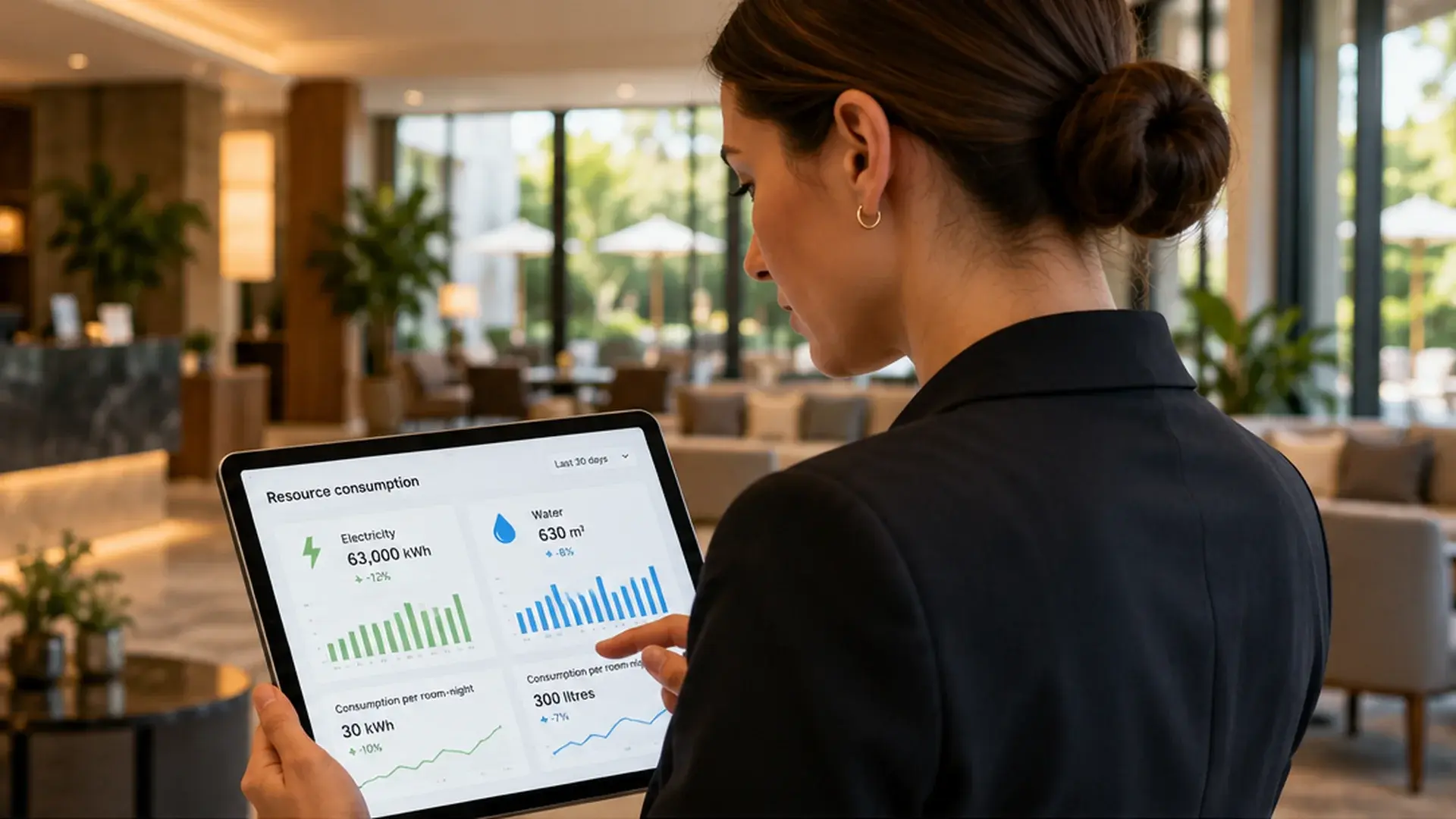
AI-generated illustration; dashboard figures are illustrative and do not represent customer results or the Noytrall interface.
What changed with Green Key in October 2026?
Green Key is an international environmental certification programme for tourism establishments, developed under the Foundation for Environmental Education (FEE).
The revised 2026–2031 criteria were published in April 2026 and took effect on 1 October. They cover seven criteria areas and distinguish between imperative criteria, which applicants must satisfy, and guideline criteria, whose required proportion increases across certification periods.
The changes affect both hotels seeking certification for the first time and establishments renewing their existing certification.
| Requirement | What hotel operators should know |
|---|---|
| Effective date | 1 October 2026 |
| Certification validity | Two years under the new system; some transition renewals receive a one-year extension |
| New applicants | Must follow the 2026–2031 criteria |
| Existing participants | Transition no later than 31 December 2027 |
| Evidence during transition | Six months of data may suffice for re-applicants where two full calendar years would normally be required |
| Assessment | Conformity with applicable criteria and the revised certification process |
The six-month provision is particularly important. It is a transitional accommodation for eligible re-applicants, not a permanent reduction in the evidence required from all hotels.
After the transition, re-applicants must provide evidence covering the previous two full calendar years wherever the relevant criteria require it.
Why this matters in Portugal
Portugal already has a substantial number of tourism establishments participating in Green Key.
According to the Portuguese programme operator, ABAAE, 459 establishments received Green Key recognition in 2026, including 13 added in September's final assessment round.
For these establishments, the revised criteria create a reason to review existing documentation practices. For new applicants, they provide an opportunity to establish effective data collection processes from the beginning.
The objective should not simply be to pass the next assessment. It should be to make environmental performance easier to understand and manage throughout the year.
Certification readiness starts with operational evidence
Consider a common situation.
A hotel has invested in efficient lighting, installed water-saving fixtures and trained its staff to reduce waste. Its environmental policy is documented, and management receives monthly utility bills.
These are valuable actions. But when asked to demonstrate whether resource efficiency has improved, the team may struggle to provide a clear answer.
Did water consumption fall because of the efficiency measures, or because occupancy was lower? Has electricity use increased because of weather conditions, additional services or equipment faults?
This is the difference between having environmental initiatives and having measurable operational evidence. It also supports the separate task of substantiating hotel sustainability claims.
A practical evidence-management system should help operators answer three questions:
- What happened? Reliable records show consumption, performance and relevant operating conditions.
- Why did it happen? Analysis helps distinguish changes in occupancy, weather and building operations from potential inefficiencies.
- What did we do about it? Maintenance logs, corrective actions and follow-up measurements document the response.
Not every Green Key criterion requires continuous digital monitoring. Some concern policies, procurement, staff training, communication or other management practices.
Nevertheless, organised consumption data can make resource-related requirements easier to address and provide management with information that remains useful beyond certification.
Selected Green Key evidence requirements for hotels
The hotel and hostel criteria and explanatory notes distinguish imperative requirements (I) from guidelines (G):
| Criterion | Status | Records to prepare |
|---|---|---|
| 3.1 Water | I | Monthly consumption by source, supporting records and collection method. |
| 4.1 Energy | I | Monthly consumption for each energy source and supporting methodology. |
| 5.6 Waste | I | Monthly and annual total, residual/mixed and food waste; Portugal also requires recyclable waste. |
| 4.27 Emissions | I | Annual Scope 1 and 2 calculations, inputs, factors and methodology for the last full reporting year and preceding year. |
| 4.28 Scope 3 | G | Relevant indirect emissions calculated under the GHG Protocol. |
Water, energy and waste normally need two calendar years of records. First-time applicants provide the last full year, or at least three months if history is unavailable. First-time carbon calculations cover the last full reporting year. Apply the transition concession only where relevant, and confirm national requirements with the programme operator.
Five areas hotels should measure and document
1. Water consumption
Water consumption is a useful starting point because it connects environmental management with operating costs. Our article on European drought and hotel water monitoring explores the operational context.
At minimum, hotels should maintain consistent records of total water consumption and the periods they cover.
Where appropriate, operators can also monitor high-consumption areas such as guest rooms, laundry, kitchens, swimming pools and irrigation.
Useful indicators include:
- Total water consumption (m³/month).
- Water consumption per occupied room-night (litres).
- Consumption by operational area, where submetering is available.
- Unusual consumption patterns and suspected leaks.
- Maintenance interventions and subsequent consumption changes.
The important distinction is between recording a monthly total and understanding what drives it.
A hotel with rising water consumption may have a leak, higher occupancy or increased irrigation demand. More granular monitoring helps investigate the cause before drawing conclusions.
2. Energy consumption
Energy records should distinguish electricity from other energy carriers, such as natural gas, LPG or purchased heating, where relevant.
Useful indicators include total electricity consumption, energy use per occupied room-night, and consumption by major system or operational area.
For hotels, HVAC, domestic hot water, kitchens, laundry and common areas can be significant loads. The relative importance of each depends on the building and its services.
Monitoring these systems can reveal changes that are difficult to identify from a single monthly bill.
For example, a rise in overnight electricity consumption during a low-occupancy period could justify investigating HVAC schedules, equipment operating continuously or other base-load contributors.
However, an alert is not proof of waste. The finding needs operational investigation and, where necessary, a documented corrective action.
3. Consumption in relation to occupancy
Absolute consumption is necessary for tracking environmental impact, but it can be misleading when comparing operational efficiency.
A hotel using 10% more water than the previous month may actually have improved its efficiency if occupied room-nights increased by 25%.
For this reason, occupancy-normalised indicators are valuable management tools.
Water intensity per occupied room-night = total water consumption (litres) ÷ occupied room-nights.
Energy intensity per occupied room-night = total energy consumption (kWh) ÷ occupied room-nights.
These indicators should complement, rather than replace, absolute totals.
They also require context. Weather, restaurant activity, conference events, laundry outsourcing and other operational changes can influence consumption independently of room occupancy.
Hotels should use consistent definitions and document any relevant changes when comparing periods.
4. Waste generation
Waste measurement is another important component of environmental management.
Operators should organise records by waste stream, using quantities supported by appropriate collection or weighing methods.
Depending on the establishment, this may include food waste, glass, paper and cardboard, plastics, residual waste and other relevant streams.
A practical record can capture the quantity, reporting period, collection method, responsible party and supporting documentation.
Waste data should not be treated as interchangeable with water and energy monitoring. Waste often requires different collection methods, supplier records and operational procedures.
5. Carbon emissions and supporting activity data
Hotels increasingly need to understand the emissions associated with their operations.
Electricity and fuel consumption provide important activity data for calculating energy-related greenhouse gas emissions.
However, consumption data alone do not constitute a complete carbon footprint.
A defensible calculation requires appropriate emission factors, defined organisational and operational boundaries, consistent methodologies and supporting records.
For hotels, purchased goods, outsourced services, waste treatment and other indirect activities may also be relevant, depending on the chosen reporting scope.
The goal is to maintain traceable source data so that emissions calculations can be explained, updated and verified.
From monitoring to evidence: a five-step workflow
Collecting data is only the beginning. Hotels need a repeatable process that connects measurement to management decisions.
- Measure: Collect consistent resource and activity data.
- Understand: Compare baselines, occupancy and consumption patterns.
- Act: Investigate anomalies and implement improvements.
- Document: Record interventions, responsible teams and outcomes.
- Verify: Review evidence quality and prepare for assessment.
This process can operate monthly, with more frequent reviews for critical equipment or unusual consumption patterns.
Each measurement should have a clearly identified source, reporting period and responsible person. Any gaps or changes in measurement methods should be documented rather than silently omitted.
For certification preparation, hotels should map these records to the applicable Green Key criteria and explanatory notes. A useful operational dashboard does not automatically satisfy a specific criterion's evidence requirements.
Practical example: A 100-room hotel preparing its evidence
Consider an illustrative 100-room hotel operating at 70% occupancy over a 30-day month.
| Monthly indicator | Illustrative baseline |
|---|---|
| Occupied room-nights | 2,100 |
| Water consumed | 630 m³ |
| Electricity consumed | 63,000 kWh |
| Water per occupied room-night | 300 litres |
| Electricity per occupied room-night | 30 kWh |
Hypothetical values for illustration, not Green Key benchmarks or Noytrall customer results.
The hotel introduces a monthly review process and identifies an unexpected rise in water consumption in one operational area.
Maintenance investigates, finds a faulty valve and replaces it. The team records the date, location, intervention and subsequent measurements.
In a later comparable period, water consumption decreases from 630 m³ to 580 m³, with the same number of occupied room-nights.
| Water indicator | Before | After |
|---|---|---|
| Total consumption | 630 m³ | 580 m³ |
| Consumption per occupied room-night | 300 litres | 276.2 litres |
Assumes 2,100 occupied room-nights in both periods; other operational conditions may differ.
The observed difference is 50 m³ (7.9%).
The difference represents 50,000 litres of water. At an illustrative variable water and wastewater cost of €3.50/m³, that would correspond to €175 in avoided charges for the comparable period.
But the hotel should not automatically attribute the entire reduction to the valve replacement. Other operational conditions may have changed.
For credible documentation, the team should retain the baseline, maintenance record, follow-up data and any relevant explanatory context.
This creates something more useful than a savings claim: a traceable record connecting an operational observation to an action and a measured outcome.
Where continuous monitoring helps — and where it does not
Continuous monitoring can reduce the effort required to collect and analyse consumption data, particularly when hotels need to maintain consistent records over multiple reporting periods.
Instead of relying exclusively on manual meter readings or retrospective utility bills, operators can access more frequent measurements and investigate changes closer to when they occur.
At Noytrall, this is the operational problem we focus on: helping hospitality teams gain visibility into water and energy consumption, identify unusual patterns and turn resource data into actionable information.
Room-level and equipment-level monitoring can complement building-wide meters, helping teams understand which areas contribute to consumption and where investigation may be useful.
However, monitoring technology is only one part of certification readiness.
It does not replace environmental policies, procurement procedures, staff training, waste documentation, independent assessment or the other evidence required by Green Key.
Monitoring software does not guarantee certification.
Its value lies in making relevant operational information easier to collect, interpret and maintain.
A 30-day plan to improve certification readiness
Hotels do not need to wait until their next assessment to organise their evidence.
A focused first month can establish the foundations for a more reliable process.
| Period | Priority action | Expected output |
|---|---|---|
| Week 1 | Review applicable Green Key criteria and existing records | Evidence gap register |
| Week 2 | Identify data sources, meters, owners and reporting periods | Measurement inventory |
| Week 3 | Define baselines and occupancy-adjusted indicators | Initial performance dashboard |
| Week 4 | Establish anomaly reviews, corrective-action logs and evidence storage | Repeatable monthly process |
This is not a substitute for a full Green Key compliance assessment. It is a practical starting point for organising the resource data and operational records that support environmental management.
The earlier hotels establish consistent measurement practices, the easier it becomes to build meaningful historical records.
Certification should be a result of good management, not a paperwork exercise
Green Key's revised framework gives hotels a timely reason to examine how they manage environmental evidence.
For new applicants, the 2026–2031 criteria already apply. Existing certified establishments should use the transition period to understand what will be required at their next assessment and strengthen any weak documentation processes.
The most useful question is not simply whether the hotel has enough records to apply.
It is whether those records help management understand consumption, investigate inefficiencies and demonstrate what has changed.
Better measurement does not guarantee certification. But it can make environmental management more effective — and the evidence behind it more reliable.
If your hotel is preparing for Green Key certification or reviewing its resource monitoring processes, explore how Noytrall supports water and energy monitoring.
Frequently asked questions
When did the new Green Key criteria take effect?
The 2026–2031 criteria apply from 1 October 2026, including to new applicants.
Do existing Green Key hotels need to reapply immediately?
Existing participants transition through renewal, with the transition ending no later than 31 December 2027. The new system grants two-year certificates; some off-site transition renewals extend existing certification by one year. Confirm your assessment timetable with the national operator.
How much historical data is required?
The period depends on the criterion and application status. Eligible re-applicants have a minimum six-month concession during transition for records otherwise requiring two full calendar years. Consult the evidence table above and the applicable explanatory notes.
Does Green Key require hotels to install smart meters?
The selected consumption-recording requirements do not impose universal smart-meter installation. The explanatory notes allow different collection methods and specified estimates in qualifying circumstances. Submetering and frequent readings can improve management, but each criterion has its own evidence requirements.
Can monitoring software help with Green Key certification?
It can support consumption records, trend analysis and operational documentation. Hotels must still maintain the other required policies, procedures and records and complete independent assessment.