Europe's Drought Is Changing the Business Case for Hotel Water Monitoring
Hotel in southern Europe during dry summer conditions highlighting water resilience challenges. Illustrative image generated with AI.
For years, hotel water efficiency has followed a familiar playbook: install lower-flow taps and showerheads, optimise toilets, encourage towel reuse and remind guests to conserve water.
Those measures still matter.
But Europe's 2026 drought conditions expose a limitation in that approach: a hotel cannot actively manage water it cannot see.
In early August 2026, the European Drought Observatory reported that drought conditions remained stable and critical in most of Europe, while watch conditions expanded in the Iberian Peninsula and Germany. The preceding month had already been exceptional. Copernicus reported that July 2026 brought drier-than-average conditions across much of western, central and eastern Europe, with surface soil moisture in parts of the Iberian Peninsula, France, Germany, Austria and Hungary at its lowest July level since at least 1979 in the ERA5-Land dataset.
Spain provides an even clearer signal. AEMET recorded just 4.3 mm of precipitation across mainland Spain in July 2026, 26% of the 1991-2020 average, making it the driest July in Spain's national series since 1961.
For hotel operators, this changes the conversation.
Water efficiency is no longer only about reducing an environmental KPI. Increasingly, it is about understanding an operational dependency before scarcity, restrictions, rising costs or infrastructure problems force the issue.
When water is plentiful, invisible waste is primarily a cost. When water becomes constrained, that same waste becomes operational exposure.
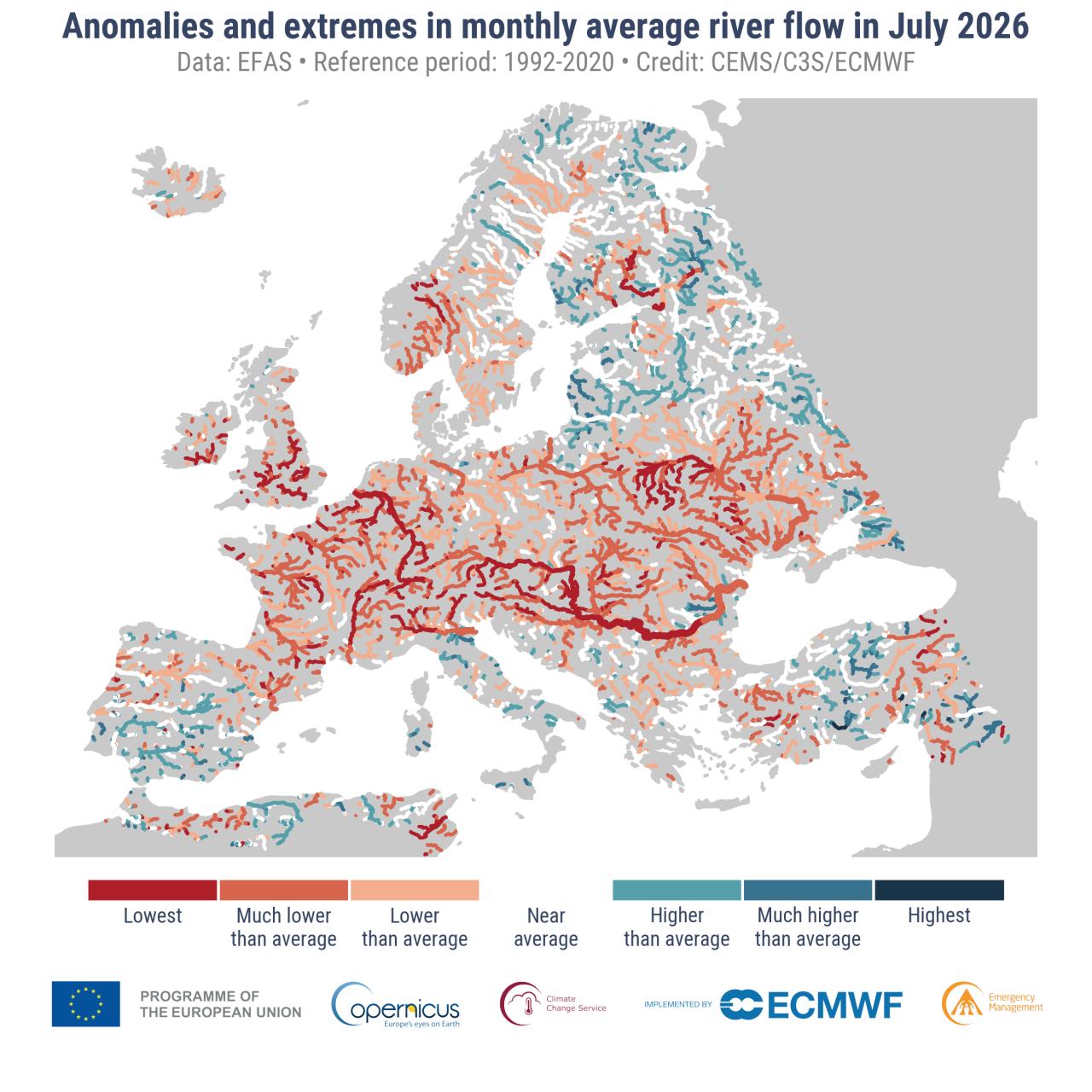
Copernicus' July 2026 river-flow map shows much-below-average flows across large parts of Europe, including several regions important to tourism and hospitality.
Why drought resilience matters for hospitality
Water scarcity is not confined to occasional extreme summers.
The European Environment Agency estimates that, on average, around 30% of EU territory and 33% of its population experience water scarcity during at least one quarter each year. In southern Europe, around 30% of the population lives in areas with permanent water stress, and up to 70% can experience seasonal summer stress. The EEA explicitly identifies tourism, agriculture and public water supply as pressures on freshwater resources in the region.
That timing matters for hospitality.
The months when Mediterranean hotels experience some of their highest occupancy can coincide with the period when local water systems are under the greatest pressure.
The issue is therefore not simply:
"How sustainable is our hotel?"
It is increasingly:
"How dependent are our operations on water, where are we wasting it, and how quickly could we respond if supply conditions changed?"
The European Commission is moving in the same direction. Its Water Resilience Strategy includes guidance to improve EU water efficiency by at least 10% by 2030, reduce leakage in pipes and accelerate the use of digital solutions. This is an EU-wide policy objective, not a requirement for every individual hotel to cut water consumption by 10%, but it shows where European water management is heading.
And the next phase is explicitly digital. In May 2026, the Commission launched work on an EU-wide Action Plan on Digitalisation in the Water Sector, including an initiative around smart meters and the deployment of IoT sensors and meters.
The principle is straightforward: better water management starts with better information.
The traditional hotel water playbook has a visibility problem
Hotels have already implemented many sensible efficiency measures.
Low-flow fittings reduce demand. Efficient toilets reduce flushing volumes. Linen programmes can reduce laundry requirements. Preventive maintenance catches known problems.
The limitation is that most of these interventions address expected consumption. They are much less effective at identifying unexpected consumption.
A water-efficient fixture can still leak
Installing an efficient toilet does not tell an engineering team whether its cistern begins running continuously six months later.
A low-flow showerhead cannot reveal abnormal use elsewhere in the room.
A water-saving policy cannot detect a pipe leak overnight.
Efficiency specifications describe what equipment should consume. Monitoring tells you what the building actually consumes.
Monthly bills arrive too late
A utility bill is useful for accounting and high-level benchmarking. Operationally, however, it is a lagging indicator.
If consumption rises significantly in the middle of August, discovering that increase on a September invoice means the hotel may already have paid for weeks of unnecessary water consumption.
And the bill still cannot tell the facilities team whether the increase came from guest rooms, irrigation, kitchens, laundry, cooling systems, housekeeping, a leaking installation or simply higher occupancy.
That is the difference between water accounting and water intelligence.
Portfolio averages can hide property-level problems
For hotel groups, annual or monthly portfolio averages can be useful for board reporting, but they can also hide operational outliers.
One efficient property can offset another property's unexplained water use in the same dashboard. A resort with high irrigation demand may look inefficient when compared with an urban business hotel, while an actual leak in the urban hotel remains invisible because the total number still looks acceptable.
Hotel water monitoring only becomes useful when consumption is connected to the context that explains it: property type, occupancy, weather, operating schedules and the area of the building being measured.
The next step is operational water visibility
A more resilient hotel water strategy begins by answering five questions.
1. Where is the water going?
A whole-building meter establishes total consumption. The next useful level depends on the property.
That might mean separating guest accommodation, kitchens and F&B, laundry, pools and spa, irrigation, cooling systems, common areas or groups of rooms.
More granular measurement is not automatically better. The goal is to collect enough information to identify actionable differences.
2. What should normal consumption look like?
A hotel operating at 95% occupancy should not be compared directly with the same property operating at 45%.
Useful baselines therefore need context. Depending on the area being monitored, operators can track indicators such as litres per occupied room-night, litres per guest-night, cubic metres per day, consumption during unoccupied periods, consumption by room or floor, consumption by operational area and consumption against comparable periods or properties.
Occupancy-aware baselines help distinguish genuine inefficiency from normal changes in demand.
3. What behaviour is abnormal?
Once a baseline exists, anomalies become easier to identify.
Examples include continuous flow in an unoccupied room, overnight consumption where little or none is expected, one room consistently consuming significantly more than comparable rooms, a sudden increase after maintenance, unusually long consumption events or consumption that fails to fall when occupancy decreases.
The objective is not simply to generate another dashboard. It is to turn unusual consumption into an operational signal.
4. What is the financial impact?
Litres alone do not always establish priority.
Convert avoidable consumption into:
Water loss x applicable water and wastewater tariff = direct financial exposure
Where hot water is involved, operators should also account for the energy needed to heat it.
This allows an engineering team to distinguish between a minor anomaly and an issue that warrants immediate intervention.
5. Did the intervention actually work?
Detection is only half of the process.
After a repair or operational change, the hotel should verify that consumption returned to the expected baseline.
That creates a simple continuous-improvement loop:
Measure -> detect -> investigate -> intervene -> verify.
It also turns sustainability reporting from a list of initiatives into evidence of measured outcomes.
What can a small hidden flow actually cost?
Consider an illustrative example.
A hotel has room-level monitoring and discovers continuous flows of approximately 0.5 litres per minute in five rooms. The cause might be leaking taps, faulty toilet mechanisms or another plumbing issue.
At first glance, 0.5 litres per minute sounds insignificant.
But one continuous 0.5 L/min flow represents:
0.5 x 60 x 24 x 365 = 262,800 litres per year
That is approximately 263 cubic metres of water.
Across five rooms:
Approximately 1,314 cubic metres per year
If the hotel's combined water and wastewater cost were, for illustration, EUR 3 per cubic metre, those five small problems would represent roughly:
EUR 3,940 per year in direct water costs.
That figure excludes energy required if any of the wasted water is heated, maintenance consequences, damage risk, staff time and the value of conserving water during periods of scarcity.
The precise economics will vary by property and tariff.
The important lesson is not the EUR 3,940. It is that small flows become large annual volumes when nobody knows they are happening.
A practical hotel water-resilience playbook
Hotels do not need to wait for formal restrictions or another record-dry summer to improve resilience.
A practical approach can start with seven steps.
Step 1: Build a water balance
Map where water enters the property and its main areas of consumption.
Start with the major operational categories rather than attempting to instrument every tap.
Step 2: Identify your visibility gaps
Ask which consumption can currently be explained and which cannot.
If total water consumption increases 15% tomorrow, could your team determine where the increase occurred?
If not, there is a measurement gap.
Step 3: Establish operational baselines
Track consumption against meaningful drivers such as occupancy, guest-nights, season, area and operating schedule.
Avoid treating absolute monthly consumption as the only performance measure.
Step 4: Define abnormal-use rules
Determine what requires attention.
Examples might include persistent flow in unoccupied rooms, abnormal night-time consumption or significant deviation from comparable rooms.
Then establish who receives the alert and how quickly it should be investigated.
Step 5: Quantify before prioritising
Translate abnormal consumption into cubic metres, euros and, where appropriate, associated energy consumption.
Facilities teams rarely lack possible interventions. They lack a reliable way to prioritise them.
Step 6: Verify every intervention
Measure consumption before and after repairs or process changes.
If the expected improvement cannot be observed, investigate why.
Step 7: Benchmark across the portfolio
For hotel groups, individual buildings can become benchmarks for one another.
Normalised data can reveal properties using more water under comparable conditions, recurring maintenance issues, successful interventions worth replicating and sites most exposed to local water scarcity.
This is where monitoring moves from maintenance support into asset management.
Smart water management does not mean metering everything
One objection to water monitoring is that highly granular measurement can sound expensive or complex.
It does not need to begin that way.
A sensible architecture can be progressive:
Property -> operational area -> room or floor -> individual source where justified
The appropriate level depends on the decision the operator is trying to make.
If the problem is unexplained irrigation consumption, adding sensors to every guest bathroom is unlikely to be the first priority.
If guest-room consumption represents a major blind spot across hundreds of rooms, aggregated utility data may be insufficient.
The question should therefore not be:
"How many meters can we install?"
It should be:
"What level of measurement would allow our team to identify and act on material waste?"
Technology only becomes useful when it shortens the distance between something going wrong and someone doing something about it.
That is the operating logic behind smart water management: use measurement, context and anomaly detection to make water performance visible before the utility bill arrives.
Europe's digital water strategy reinforces that direction
This measurement-first approach is increasingly reflected in European water policy.
The Commission's forthcoming digitalisation action plan is focused on smart meters, IoT deployment and data-driven management. Its May 2026 call for evidence cited potential water-use reductions of up to 25% from smart metering, alongside further savings associated with digital systems and leak detection.
Those figures are water-sector estimates, not guaranteed savings for an individual hotel, and they should not be presented as such.
But the mechanism behind them is directly relevant to hospitality:
Visibility makes losses easier to find, and faster detection makes losses easier to stop.
For hotels, the important shift is therefore not from non-digital to digital. It is from periodic accounting to continuous operational awareness.
Water data can serve operations, finance and ESG at the same time
Better water visibility also resolves a common organisational problem.
Facilities teams need information to find problems. Finance needs information to understand cost. ESG teams need information to demonstrate performance.
Historically, those needs often produce separate spreadsheets, estimates and reporting exercises.
A measured operational dataset can support all three.
The same baseline used to identify an abnormal room can later demonstrate how much water was avoided, whether efficiency improved, the financial value of the intervention and the evidence behind a sustainability KPI.
That is the measurement-first approach Noytrall applies to resource monitoring and sustainability data for hotel operations: connect building and room-level consumption, operational context and anomaly detection so teams can act on measured behaviour rather than waiting for utility bills.
The sustainability benefit remains important.
But in a Europe increasingly exposed to water scarcity, the business case is becoming broader.
Water efficiency is becoming part of business continuity.
And for hotels in water-stressed regions such as the Iberian Peninsula, knowing where every unnecessary cubic metre is going may soon matter as much as knowing how much it costs.
Make your hotel's water blind spots visible
If your team can see total water consumption but cannot explain where it is going, what normal looks like or which anomalies deserve attention, that is the place to start.
Book a 20-minute Noytrall walkthrough to map the water visibility gaps in your property and identify where more granular monitoring could create operational value.
FAQ
Why is water monitoring important for hotels?
Hotel water monitoring helps operators understand where water is being consumed, establish normal consumption levels and detect leaks or abnormal use earlier. This is increasingly important as European water scarcity raises both the financial and operational consequences of wasted water.
How can hotels reduce water consumption without affecting guests?
Start with operational waste before reducing guest service. Leak detection, maintenance, occupancy-aware monitoring, efficient equipment and better control of irrigation, laundry and other building systems can reduce unnecessary consumption without asking guests to accept lower service levels.
Are smart water meters required for hotels in the EU?
There is currently no general EU requirement forcing every hotel to install smart water meters. However, the EU Water Resilience Strategy aims to improve water efficiency by at least 10% by 2030, and the Commission is developing a water-sector digitalisation action plan that includes an EU-wide smart-metering initiative.
What water KPIs should a hotel track?
Useful KPIs can include litres per occupied room-night, litres per guest-night, cubic metres per operating area, night-time consumption, abnormal-flow events, leak-response time and water cost per occupied room. The appropriate metrics depend on the type of property and available measurement infrastructure.
Does a hotel need to meter every tap and shower?
No. Monitoring should match the operational decision being made. Many properties can start at building or operational-area level and add room or source-level monitoring where additional granularity is likely to reveal actionable waste.
Sources
- Copernicus Climate Change Service: precipitation, relative humidity, soil moisture and river flow for July 2026
- European Drought Observatory: current drought situation in Europe
- AEMET: Spain July 2026 climate summary
- European Environment Agency: water scarcity conditions in Europe
- European Commission: Water Resilience Strategy
- European Commission: digital action plan for the water sector