EU Sustainable Tourism Strategy: A Guide for Hotels
Europe has a new roadmap for tourism. On 4 November 2026, the European Commission presented its EU Sustainable Tourism Strategy, outlining how the sector can become more competitive, sustainable and resilient.
For hotels, the message goes beyond environmental commitments. The strategy places sustainability alongside business competitiveness, digitalisation, skills development and destination management.
This matters because hotels operate at the intersection of several challenges: rising pressure on natural resources, climate-related disruptions, seasonal demand and the need to deliver consistent guest experiences.
The opportunity is to make sustainability part of everyday operational performance, rather than treating it as a separate reporting exercise.
Here is what the strategy proposes, what it does not require, and how hotel operators can prepare.
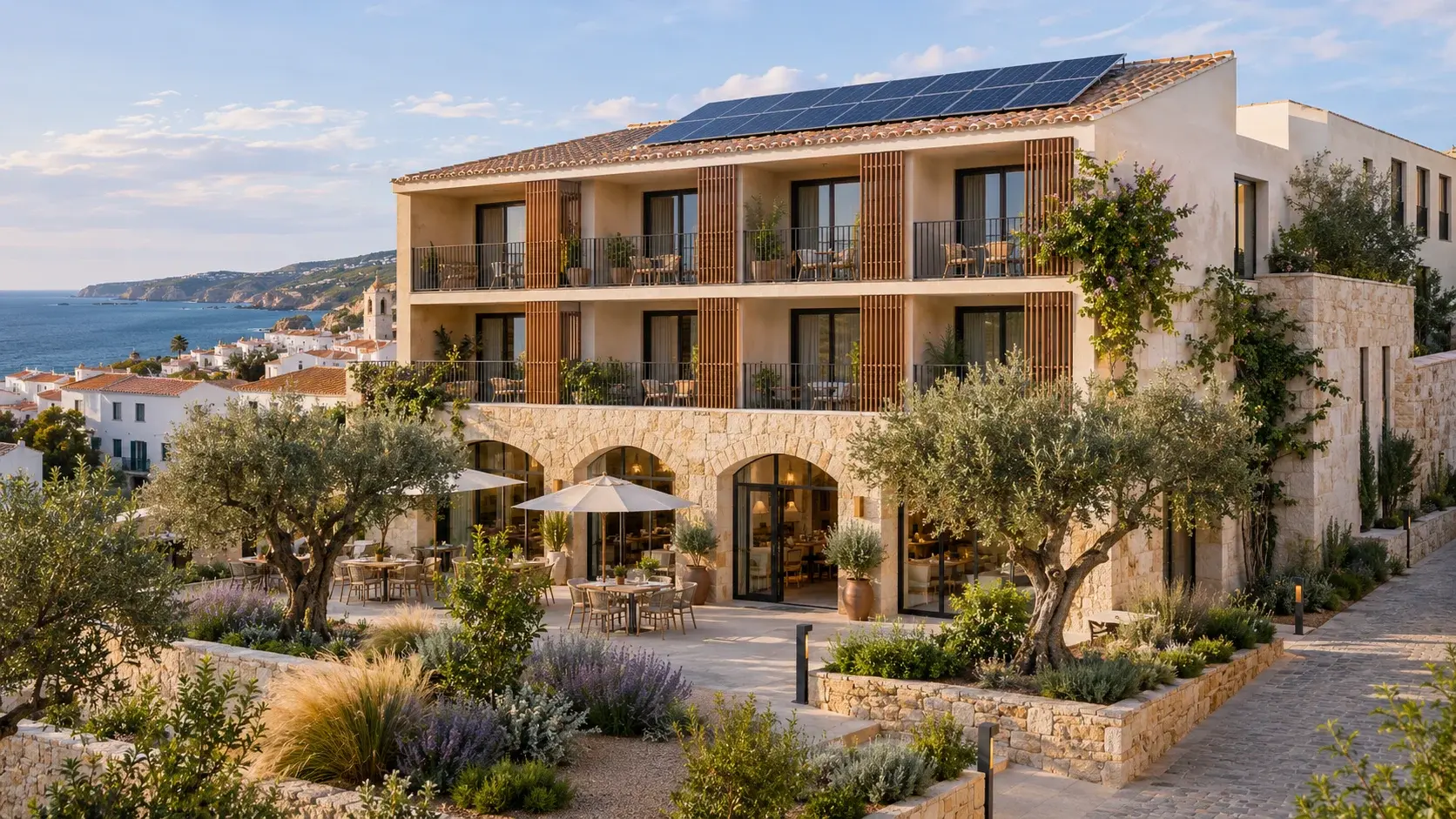
Illustrative image generated with AI; does not depict a real hotel.
Why Europe needs a new tourism strategy
Tourism remains one of Europe's most important economic activities.
According to the European Commission, the sector:
- Contributes approximately 10% of EU gross value added, including direct, indirect and induced effects.
- Supports more than 20 million jobs.
- Includes approximately 5 million businesses, 99% of which are SMEs.
- Accounts for approximately 40% of international tourist arrivals worldwide.
Yet the sector's scale creates challenges.
Popular destinations face concentrated visitor demand. Hotels must manage energy and water consumption, particularly during peak seasons. Climate change introduces further uncertainty, from drought and extreme heat to disruptions affecting infrastructure and travel.
Meanwhile, many hospitality businesses operate with limited staff, fragmented data and restricted investment capacity.
The European Commission's response is not simply to encourage more tourism. It is to support a sector capable of generating lasting economic and social value while managing its environmental pressures.
What does the EU Sustainable Tourism Strategy propose?
The strategy builds on the 2022 Transition Pathway for Tourism and the European Agenda for Tourism 2030.
It is organised around three main pillars and ten action areas. The overview below focuses on the initiatives most relevant to hotel operations.
1. Strengthening tourism competitiveness
The first pillar focuses on helping European tourism businesses innovate, develop skills and improve productivity.
Among the proposed initiatives are:
- EU Tourism Academy: supporting skills development across the sector.
- EU Tourism Observatory: improving access to tourism intelligence.
- Common European Tourism Data Space: supporting data sharing and digital innovation.
- EU tourism simplification initiative: examining opportunities to reduce unnecessary administrative burdens.
For hotels, these initiatives signal the importance of digital capabilities and reliable information.
Digitalisation should not mean collecting data without purpose. Its value comes from helping teams make better decisions, identify inefficiencies and improve service delivery.
2. Building sustainability and resilience
The second pillar addresses the long-term environmental and operational resilience of European tourism.
The Commission intends to support cleaner and more circular tourism activities, balanced destination development, accessibility and crisis preparedness.
Flagship actions include an EU Model for Tourism Management, a Toolbox for Balanced Tourism and an EU Tourism Crisis Coordination Network.
For hospitality operators, this creates a useful framework for thinking beyond individual environmental initiatives.
Reducing unnecessary water consumption, improving energy efficiency and preparing for resource disruptions can contribute to both sustainability and operational continuity.
3. Promoting Europe as a leading destination
The third pillar focuses on international cooperation, destination promotion and stronger coordination across tourism stakeholders.
The strategy also proposes a new EU Tourism Alliance to bring together authorities, businesses and other organisations.
This is relevant because the sustainability of a destination cannot be achieved by hotels acting alone.
Transport systems, public infrastructure, water availability, local communities and tourism businesses all influence the visitor experience.
A hotel can improve its own operations while also contributing reliable information and practical experience to broader destination-level initiatives.
Why operational data matters for sustainable hotels
One of the strategy's most relevant developments is its emphasis on digital tools and data.
For hotels, however, there is an important distinction between having data and being able to act on it.
A monthly utility invoice shows how much electricity or water a property consumed. It rarely explains where consumption occurred, whether it was necessary or what changed compared with normal operations.
More granular monitoring can help answer operational questions:
- Is water consumption unusually high relative to occupancy?
- Does electricity demand remain elevated in low-occupancy periods?
- Are certain building systems consuming energy outside their expected operating schedules?
- Did a maintenance intervention produce measurable improvements?
- Can reported sustainability results be traced to consistent operational records?
These questions turn environmental information into management information.
Start with meaningful performance indicators
A practical hotel monitoring framework can include:
| Indicator | What it helps assess |
|---|---|
| Water consumption per occupied room-night | Water efficiency relative to guest activity |
| Electricity consumption per occupied room-night | Energy performance adjusted for occupancy |
| Base electricity load | Consumption when operational demand is low |
| Peak demand | Opportunities to manage electrical loads |
| Water consumption by zone | Unusual patterns and potential inefficiencies |
| Consumption against a comparable baseline | Whether interventions are producing results |
These indicators should be interpreted carefully. Weather, occupancy, hotel facilities and service levels can significantly affect consumption.
For example, a resort with swimming pools, extensive landscaping and a spa should not be directly compared with a limited-service city hotel using a single consumption metric.
Measurement is most valuable when it supports fair comparisons and specific operational decisions.
From visitor numbers to lasting value
A particularly important principle in the new strategy is the shift towards more balanced tourism.
The Commission is seeking to distribute tourism benefits more effectively across regions and seasons, while protecting local communities and strengthening destination resilience.
For hotels, this raises a useful question:
How much value does a property create relative to the resources it consumes?
Occupancy and revenue remain essential business indicators. But they do not tell the whole story.
A hotel might increase its room sales while simultaneously experiencing disproportionate growth in water consumption, energy costs or waste generation.
Another property might improve operational efficiency while maintaining guest satisfaction and service quality.
The second outcome creates value that is not visible through occupancy figures alone.
Hotels can therefore complement traditional commercial indicators with measures such as:
- Energy cost per occupied room-night.
- Water consumption per guest-night.
- Resource savings from verified interventions.
- Maintenance incidents detected and resolved.
- Waste generation per guest-night, where reliable measurement is available.
The objective is not to replace financial performance indicators, but to understand how operational efficiency supports long-term profitability and resilience.
A practical 90-day action plan for hotels
The new strategy does not require every hotel to install monitoring technology or introduce new sustainability reporting systems immediately.
Nevertheless, operators can use its direction to assess their current capabilities.
Days 1–30: Establish a reliable baseline
Begin with existing utility bills, occupancy records and available building management data.
Identify:
- Total electricity and water consumption.
- Consumption per occupied room-night.
- Major consuming systems or operational zones.
- Periods with unusual demand.
- Gaps in data quality and monitoring coverage.
Where possible, compare equivalent periods and account for occupancy, seasonality and weather.
The goal is to understand current performance before setting improvement targets.
Days 31–60: Identify and prioritise opportunities
Once a baseline is available, examine the largest or least predictable sources of consumption.
Potential interventions include adjusting equipment schedules, investigating unexpected overnight demand, checking for water leaks and reviewing HVAC operating patterns.
Prioritise actions using three criteria: expected impact, implementation cost and operational complexity.
Not every improvement requires capital expenditure. Some begin with better operating schedules, maintenance procedures or staff awareness.
Days 61–90: Implement, measure and verify
Select a manageable number of interventions and establish how their effects will be measured.
For each action, record:
- The problem identified.
- The intervention and implementation date.
- The baseline used for comparison.
- The observed consumption change.
- The estimated financial impact.
- Any limitations affecting the results.
Where conditions differ substantially before and after an intervention, adjust the comparison or clearly disclose the limitations.
This produces evidence that can support operational decisions, investment proposals and credible hotel sustainability claims. It can also inform solar and battery investment decisions and the resource records used in sustainability certification.
Example: Identifying unnecessary electricity consumption
Consider an illustrative 100-room hotel with an average electricity demand of 15 kW during a period when most non-essential services should be inactive.
After reviewing equipment schedules, the maintenance team identifies 3 kW of avoidable continuous demand.
If the reduction is maintained for eight hours per day:
3 kW × 8 hours × 365 days = 8,760 kWh annually.
At an illustrative electricity cost of €0.18/kWh, this represents approximately €1,577 in annual electricity savings.
The calculation excludes implementation costs, demand charges and any changes in operating conditions. It is a hypothetical example, not a measured Noytrall customer result.
The important point is the process: detect an inefficiency, investigate its cause, implement a correction and verify the outcome.
What does this mean for Portuguese hospitality?
Portugal offers a particularly relevant context for the strategy.
Tourism plays a significant role in regional economies, while hotels must respond to seasonal demand, varying building characteristics and local environmental pressures.
In areas affected by water scarcity, especially during dry periods, water efficiency can become a matter of operational resilience. Our article on European drought and hotel water monitoring explores this challenge.
Similarly, energy-intensive services such as cooling, domestic hot water, kitchens and laundry create opportunities for improved monitoring and control.
For Portuguese hotel operators, three priorities stand out.
First, understand resource consumption in relation to occupancy. Total consumption alone can conceal inefficiencies or exaggerate changes caused by variations in guest numbers.
Second, prioritise the systems that matter most. A targeted monitoring approach can be more useful than deploying technology everywhere without a clear operational objective.
Third, build evidence before communicating results. Reliable consumption records and documented interventions make sustainability reporting more credible and useful.
These actions align with the strategy's direction without depending on the timing of future EU initiatives.
Does the strategy introduce new legal obligations for hotels?
Not directly.
The EU Sustainable Tourism Strategy is a European Commission policy roadmap. Its publication does not, by itself, create a new obligation for every hotel to install sensors, report specific resource indicators or obtain sustainability certification.
Some proposed actions may lead to future initiatives, guidance or legislation. Their precise implications will depend on subsequent decisions and implementation.
Hotels must continue assessing their existing obligations under applicable EU and national legislation separately.
This distinction matters: preparing for a policy direction is sensible, but presenting voluntary operational improvements as mandatory EU compliance would be misleading.
How Noytrall supports measurement-led hotel sustainability
At Noytrall, we believe that sustainable hotel operations start with understanding how resources are actually used.
Our platform helps hospitality teams monitor water and electricity consumption, identify unusual patterns, analyse performance and turn operational data into actionable information.
With monitoring capabilities and reporting tools, hotels can move from periodic consumption reviews towards more informed resource management.
The purpose is not simply to collect more data. It is to help teams identify opportunities, evaluate interventions and communicate results supported by evidence.
The new EU Sustainable Tourism Strategy reinforces the relevance of this approach: competitiveness, sustainability and digitalisation are increasingly connected.
From European ambition to hotel-level action
Europe's new tourism strategy establishes a direction for the coming years: a sector that remains globally competitive while becoming more sustainable, balanced and resilient.
For hotel operators, the most useful response is not to wait for every initiative to be implemented.
It is to understand current performance, identify avoidable resource consumption and build the capability to measure improvements.
The hotels best prepared for this transition will be those able to connect environmental performance with operational decisions and business value.
Want to understand where your hotel could improve resource efficiency?
Explore how Noytrall supports water and electricity monitoring, or book a demo to discuss your hotel's resource-management priorities.
Frequently asked questions
What is the EU Sustainable Tourism Strategy 2026?
It is a European Commission policy strategy presented on 4 November 2026 to strengthen the competitiveness, sustainability and resilience of European tourism through coordinated initiatives covering businesses, destinations, skills, digitalisation and governance.
Is the EU Sustainable Tourism Strategy mandatory for hotels?
No. The strategy itself does not impose new direct monitoring or reporting requirements on all hotels. Existing legal obligations and any future implementing measures must be assessed separately.
How does the strategy support tourism digitalisation?
It proposes initiatives including the EU Tourism Observatory and the Common European Tourism Data Space, alongside measures to improve access to digital tools, data and skills.
How can hotels align with the strategy?
Hotels can improve their understanding of resource consumption, prioritise operational efficiency, strengthen data quality, develop staff capabilities and contribute to destination sustainability initiatives.
Does the strategy provide funding for sustainable hotels?
The Commission intends to support tourism-related activities through relevant EU funding programmes and instruments. However, the strategy's publication does not establish an automatic grant entitlement for individual hotels.