Sustainable Hospitality 2026: A Year to Prepare, Not Pause
Europe’s hotel industry has been granted a short breather on sustainability reporting. But make no mistake — the direction of travel is unchanged.
While the EU temporarily delayed parts of the Corporate Sustainability Reporting Directive (CSRD), hospitality leaders are using this window not to slow down, but to prepare smarter. The next phase of ESG in hospitality is about proof, not promises — and data will decide who leads.
The EU’s Sustainability “Pause” — What It Really Means
The European Commission’s 2025 decision to delay full CSRD implementation gives hotels a little extra time to adapt. But that’s not a retreat from regulation — it’s a reset for readiness.
Many operators still struggle to consolidate basic environmental data: energy consumption per room, waste diversion rates, supplier footprints. The pause is a chance to build those systems before they become mandatory disclosures.
At Noytrall, we see this as an operational gift: time to put measurement infrastructure in place — sub-metering, waste tracking, supplier reporting — so compliance becomes automatic, not reactive.
From Compliance to Competitiveness: CSRD’s Hidden Advantage
Sustainability reporting isn’t just an administrative task. It’s fast becoming a competitive advantage.
Corporate travel buyers and institutional investors now screen hotel portfolios for ESG maturity. A verifiable data trail — aligned with CSRD, GRI, or ISO 14001 — can directly affect occupancy, brand preference, and access to green finance.
For GMs and asset owners, the math is simple:
- Reducing energy waste by 20% typically saves €250–€400 per room per year.
- Verified sustainability performance can lift ADR by 5–10% in B2B and MICE segments.
When measurement drives management, sustainability becomes profit logic, not PR.
Net-Positive Hospitality Takes Centre Stage
The 2025 World Sustainable Travel & Hospitality Awards signalled a shift in mindset: from “less bad” to “net positive”.
Winning hotels and destinations are going beyond neutral emissions — investing in biodiversity restoration, community benefit, and circular resource loops. This is not marketing spin; it’s risk management for a carbon-constrained world.
As regulators tighten and guests grow more climate-literate, “eco-friendly” is no longer enough. The leaders are those who create local value — from sourcing and staff training to water reuse and waste-to-resource systems.
For most hotels, the first step toward “net positive” isn’t a new initiative. It’s visibility: knowing where your building stands today.
Portugal’s Example — Gandum Village and the Future of Regenerative Hospitality
Portugal is setting a new benchmark for sustainable tourism. Gandum Village was recognised by Condé Nast Johansens as “Best for Green Practices & Sustainability” — and for good reason.
Located in the Alentejo, Gandum Village embodies sustainability as a whole-system practice, where architecture, energy, and community are designed to work together.
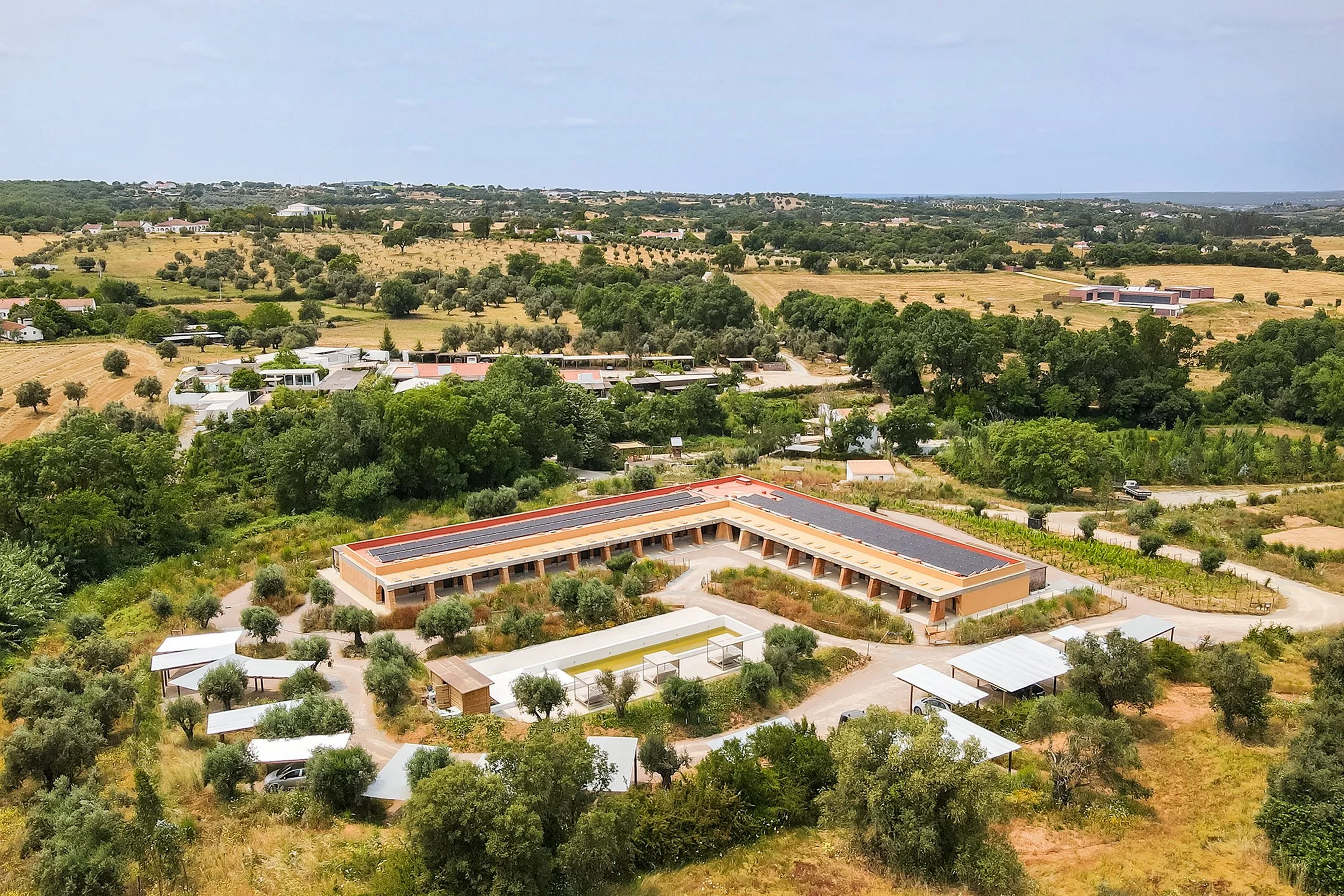
1. 100% Renewable and Locally Balanced Energy
All power on-site is generated through solar panels, achieving net-zero energy balance. Any imported energy comes exclusively from Coopérnico, a Portuguese renewable energy cooperative.
2. Earth-Based Architecture
The main hotel building is built in rammed earth (taipa) — a traditional, biodegradable material that replaces high-emission cement. This lowers embodied carbon while preserving vernacular construction techniques.
3. Circular Water and Waste Systems
Gandum reuses greywater for irrigation, composts ETAR sludge as nutrients for agroforestry, and continuously seeks to close loops between waste, soil, and food systems.
4. Smart Buildings and Transparent Data
Each room and building is equipped with real-time monitoring of water and energy use. Guests will be able to access their consumption data — turning awareness into action and embedding sustainability in the stay experience.
5. Regenerative Economy and Local Value
Beyond environmental practices, Gandum is a circular local economy:
- Built with regional materials and labour;
- Employs local residents with above-average wages;
- Sources from nearby producers;
- Reinvests profits into community regeneration and biodiversity projects.
In Gandum’s model, sustainability isn’t a label — it’s the operating system of the hotel. For other European operators, it’s proof that a profitable, measurable, community-rooted hospitality model is not just possible — it’s already here.
How Hotels Can Use 2026 to Get Ahead
Use this transition year to turn sustainability into operational discipline:
1. Audit your baseline
Collect building data across energy, water, and waste. Even partial coverage (80%) gives clarity on your biggest cost and carbon drivers.
2. Embed sustainability into daily operations
Integrate sustainability into SOPs — housekeeping, F&B, maintenance.
For example:
- Smart HVAC scheduling saves 15–25% on heating/cooling.
- Linen reuse can cut laundry water use by 30–40%.
3. Build your disclosure and investment systems
Start mapping your data flows to CSRD or GRI categories. Even if you’re not yet required to report, early alignment prevents fire drills later.
4. Differentiate through guest experience
Communicate results, not claims. Example: “This property reduced waste 18% year-on-year” tells a better story than generic “eco-friendly” badges.
Common Pitfalls and How to Avoid Them
| ❌ Mistake | ✅ Better Approach |
|---|---|
| Treating sustainability as an add-on | Integrate it into daily operations, KPIs, and team training — it’s part of core performance, not decoration. |
| Waiting for regulations | Use the regulatory delay to experiment, pilot projects, and benchmark performance before compliance becomes mandatory. |
| Relying on eco-labels without data | Track quantifiable results — energy (kWh/m²), water (L/guest-night), waste (kg/cover) — instead of symbolic certifications. |
| Disconnecting guest and asset value | Tie sustainability to guest experience and asset performance using verified metrics in marketing and investor reports. |
| Neglecting staff engagement | Build a culture of accountability — empower every team member to identify savings and sustainability improvements. |
What Comes Next — A Measurement-First Future
The next chapter of sustainable hospitality won’t be written in marketing decks — it will be logged in meter readings and verified reports.
Hotels that use 2026 to digitise and verify their resource data will stand out when CSRD enforcement resumes. Investors and guests alike will reward clarity, not claims.
At Noytrall, our platform helps hotels and building operators turn sustainability from a reporting headache into a daily performance advantage — from data capture to verified impact metrics.
💡 Ready to See Your Baseline?
Book a 20-minute walkthrough to discover how your building can measure, optimise, and prove its sustainability impact — before regulations demand it.
FAQs
1. What does the CSRD delay mean for hotels?
It delays mandatory disclosure deadlines slightly but not the direction of regulation. It’s a chance to prepare systems, not pause progress.
2. What is “net-positive” hospitality?
A model where hotels give back more — to the environment and community — than they consume, through local sourcing, biodiversity, and circular economy practices.
3. How can sustainability improve profitability?
Energy efficiency alone can cut utility costs by 15–30%. Verified ESG data attracts investors and corporate clients.
4. What tools help with sustainability reporting?
Platforms like Noytrall centralise building data, automate ESG reporting, and benchmark performance against peers.
5. Where should hotels start?
Begin with a data audit — measure energy, water, and waste. Once you can measure it, you can manage it.