
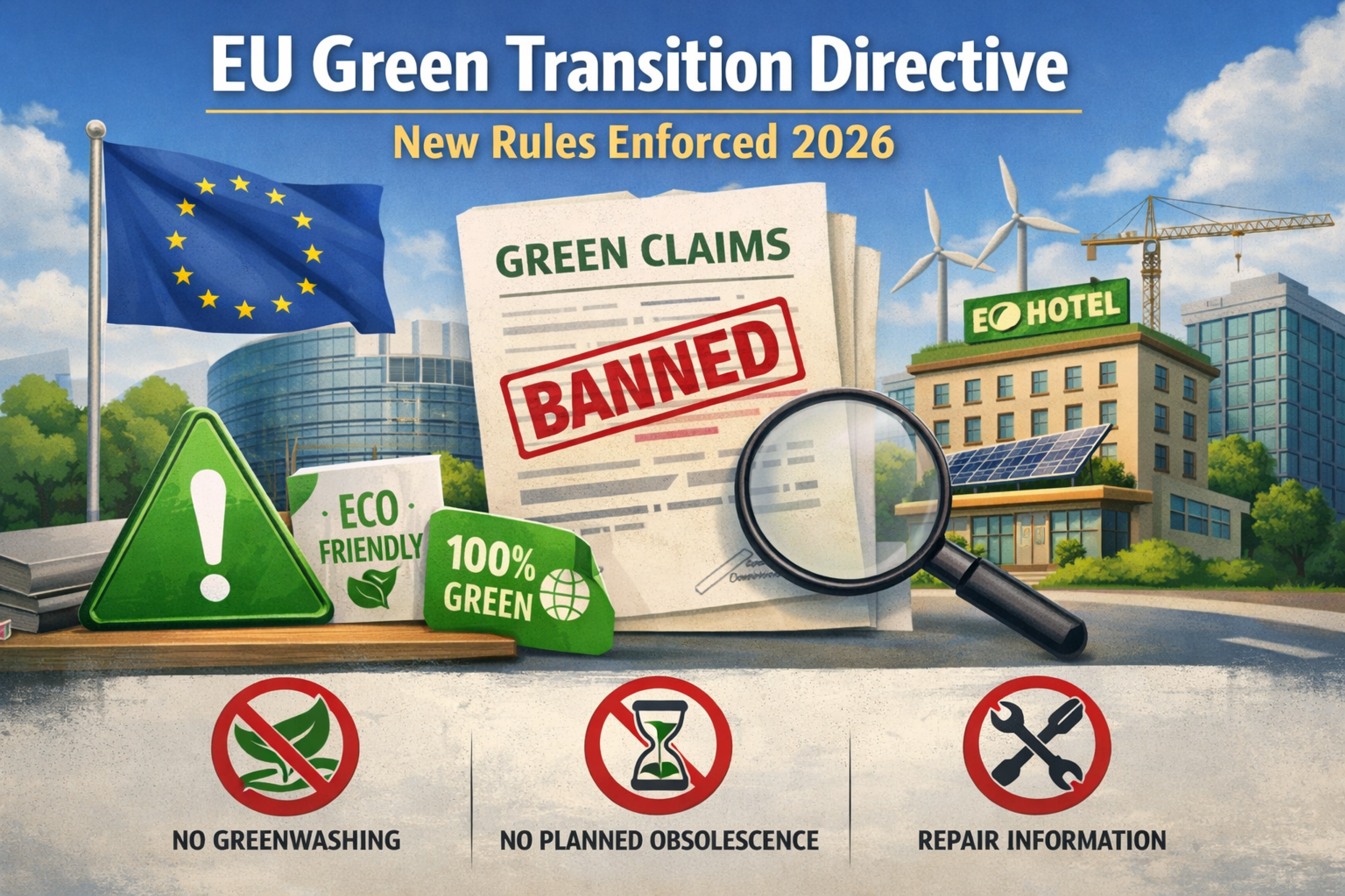
Green claims are no longer a marketing decision. They are a compliance risk.
In early 2024, the EU adopted the Empowering Consumers for the Green Transition Directive (EU 2024/825) — a cornerstone of the European Green Deal designed to eliminate greenwashing and force evidence-based sustainability communication.
By 27 March 2026, all Member States must transpose it into national law.
By 27 September 2026, it will be actively enforced.
For real estate owners, hotel groups, facility managers, and ESG teams, this directive quietly changes the rules of the game:
If you can’t prove a sustainability claim with data, you shouldn’t be making it.
This article breaks down what the directive actually requires, why it matters for the built environment, and what operators should start fixing now.
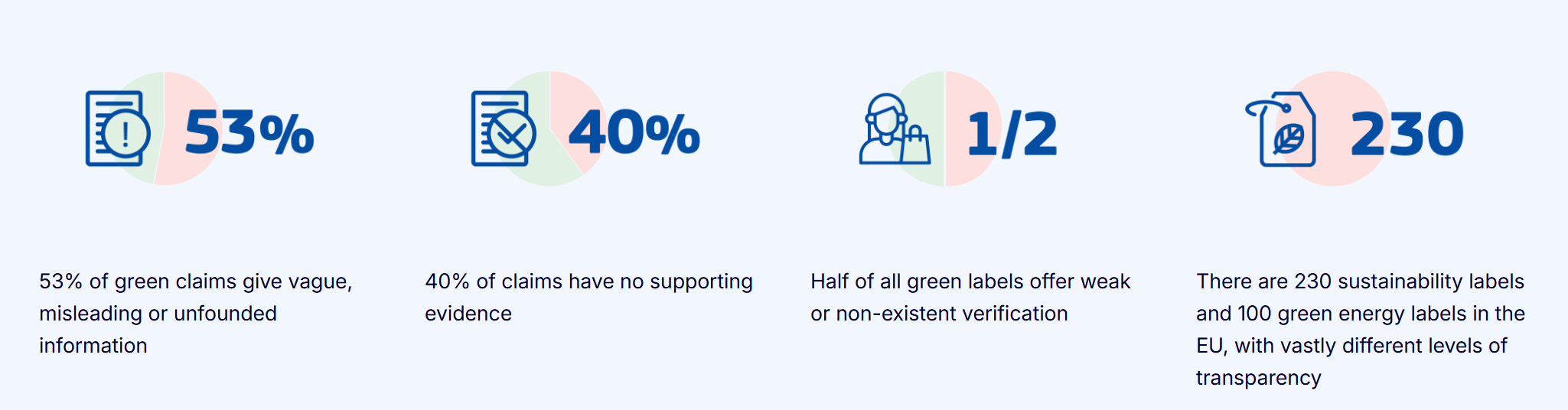 European Comission data on green claims
What Is the Empowering Consumers for the Green Transition Directive?
The directive amends two existing pillars of EU consumer law:
- The Unfair Commercial Practices Directive (UCPD)
- The Consumer Rights Directive (CRD)
Its goal is simple but disruptive:
make sustainability claims reliable, comparable, and enforceable.
It targets three systemic problems:
- Greenwashing
- Premature obsolescence
- Lack of transparency on durability and reparability
And it applies to almost all consumer-facing products and services — including accommodation, building services, equipment, and utilities marketed to end users.
1. Vague Green Claims Are Explicitly Banned
Terms like:
- “eco-friendly”
- “green”
- “natural”
- “carbon neutral”
- “climate positive”
are now considered misleading by default unless backed by clear, verifiable, and relevant evidence.
This aligns with the European Commission’s Green Claims initiative, which requires that environmental claims be:
- Based on recognised scientific methods
- Cover the full lifecycle where relevant
- Externally verifiable
Why this matters for buildings & hotels
Common risk areas include:
- “Sustainable hotel” badges with no methodology
- “Low-carbon building” claims without measured Scope 1–2 data
- “Eco rooms” or “green stays” based solely on towel reuse policies
Intent no longer matters. Evidence does.
2. Sustainability Labels Must Be Legitimate
The directive bans:
- Self-created sustainability labels
- Labels not based on approved certification schemes
- Visual badges that imply third-party verification where none exists
Practical impact
If you use:
- Custom ESG icons on your website
- Internally invented “green ratings”
- Marketing badges without traceable standards
You may need to remove or replace them with:
- Recognised schemes (e.g. EU Ecolabel, national schemes)
- Plain-language, data-backed statements
3. Durability & Reparability Must Be Disclosed
Before purchase, consumers must receive clear information on:
- Product reparability (e.g. repair scores, where applicable)
- Availability of spare parts
- Length of commercial guarantees
While this is often discussed in the context of electronics, it also affects:
- In-room equipment
- Appliances
- Building systems marketed with durability claims
- Service contracts that imply long-term performance
For operators, this changes procurement narratives
If you claim:
“Long-lasting”, “designed for durability”, or “reduced lifecycle impact”
You must be able to show maintenance strategy, expected lifetime, or repair pathways — not just brand positioning.
4. Premature Obsolescence Practices Are Prohibited
The directive bans practices that artificially shorten product life, including:
- Software updates that degrade performance without disclosure
- Design choices that block repair or replacement
- Marketing that encourages unnecessary replacement
For smart buildings and connected hotels, this is particularly relevant.
Example risk
- Digital systems marketed as “future-proof”
- Later updates increase energy use or reduce interoperability
- No clear disclosure to the customer
This is now a consumer protection issue, not just a technical one.
Timeline: When This Becomes Enforceable
| Milestone | Date |
|---|---|
| Directive adopted | Early 2024 |
| Member State transposition deadline | 27 March 2026 |
| Enforcement starts | 27 September 2026 |
That gives operators ~18–24 months to fix claims, systems, and data gaps.
What Most Organisations Get Wrong (and Why It’s Risky)
Common mistakes:
- Treating sustainability as branding, not documentation
- Relying on supplier claims without verification
- Measuring some things, but communicating everything
- Confusing good intent with compliance
The directive removes ambiguity:
If you say it, you must prove it.
The Measurement-First Alternative
Instead of starting with claims, start with:
- Measured resource use (energy, water, waste, IAQ)
- Operational baselines per building or site
- Traceable improvement actions
- Auditable data trails
Only then do sustainability claims become:
- Specific
- Comparable
- Defensible under EU law
Practical Checklist
If you manage buildings or hospitality assets, start here:
- ☐ Audit all public sustainability claims (website, booking platforms, signage)
- ☐ Remove vague or absolute wording
- ☐ Link claims to measurable indicators
- ☐ Review labels and certifications for legitimacy
- ☐ Align procurement claims with actual durability data
- ☐ Ensure ESG reporting and marketing use the same numbers
Final Thought
The Empowering Consumers for the Green Transition Directive doesn’t punish sustainability.
It punishes unproven sustainability.
For operators who already measure, optimise, and document performance, this directive is less a threat than a filter — separating real impact from noise.
If you want to sanity-check your building or hotel’s sustainability claims before regulators do,
book a 30-minute walkthrough to see how measurement-first ESG data supports compliant communication.